Wednesday, March 07, 2012

“The Hysterical Light Of Electricity”


“What are you doing out so late wandering around? How old are you?”

They walked in the warm-cool blowing night on the silvered pavement and there was the faintest breath of fresh apricots and strawberries in the air, and he looked around and realized this was quite impossible, so late in the year.

There was only the girl walking with him now, her face bright as snow in the moonlight, and he knew she was working his questions around, seeking the best answers she could possibly give.

“Well,” she said, “I’m seventeen and I’m crazy. My uncle says the two always go together. When people ask your age, he said, always say seventeen and insane. Isn’t this a nice time of night to walk? I like to smell things and look at things, and sometimes stay up all night, walking, and watch the sun rise.”

They walked on again in silence and finally she said, thoughtfully, “You know, I’m not afraid of you at all.”

He was surprised. “Why should you be?”

“So many people are. Afraid of firemen, I mean. But you’re just a man, after all . . .”

He saw himself in her eyes, suspended in two shining drops of bright water, himself dark and tiny, in fine detail, the lines about his mouth, everything there, as if her eyes were two miraculous bits of violet amber that might capture and hold him intact. Her face, turned to him now, was fragile milk crystal with a soft and constant light in it. It was not the hysterical light of electricity but—what? But the strangely comfortable and rare and gently flattering light of the candle.


from Fahrenheit 451
by Ray Bradbury


A style of painting, really a technique,
called ‘chiaroscuro,’ was invented
sort of in early Renaissance drawings—
extreme, even excessive, lights and darks
made shapes and scenes vivid and exciting.
Painters embraced the technique for drama.
Sometimes the intense light was religious.
Sometimes the light came from no source at all.
Often figures leaned toward dazzling candles
and candle light provided a bright glare
illuminating the nearby features
and quickly turning to pure black shadows
even close at hand in the mid-distance.

Now all light is the hysterical light
of electricity and images
are all photography’s hysteria,
even drawings and paintings mimic it.

How can anyone draw, paint, anyone
in this light, lost in the hysteria?

How can anyone look at anyone
in this light, lost in the hysteria?

The cameras built into phones these days
convert the hysteria to a grid.
Nothing gets lost in the rows and columns.


. . . . . . . . . . . . . . . . . . . . . . . . . . . . . . . . . . . . . . . . . . .


The Question Clarisse Asks Montag


Rocket Summer People


There’s A Hand Raising A Phone


This Woman And A Flickering Candle


Tuesday, March 06, 2012

Watercolors, Liminal Entities And Scripts


This is a watercolor painting, “Woman and Child on a Balcony,” by Berthe Morisot. It was painted around 1872 and Morisot also created an oil painting with an almost identical image. Here is the oil painting.


Painters typically create watercolor sketches to try out compositions before working in oil, but with the Impressionists sometimes they created watercolors based on oil paintings that they felt were very successful compositions. These images only have two or three differences so it seems clear one was copied from the other.

These are the best copies I could find, but they are not all that good. Can you see the differences between the watercolor and oil versions of this scene? And can you see the mistakes in one of the versions?

Today’s post is going to be a little strange. I’m going to talk about these two paintings and the slight differences between them in some detail. Then I’m going to close with a quote that I feel is inextricably bound to the topic of painting and image-making in general.

First of all, aren’t these images beautiful? I look at these and if I were the kind of person who was ever at a loss for words, these images would do it to me. But, really, I’m not, so I’m going to talk about these things.

I posted a little image of the oil version once before, when I did five posts about Morisot. This image is so typical of her. There is the pairing of the middle-age woman and the child. There is the intense sense of two places, here and there, the Parisian fringe and the city center. The woman, bound to the fringe by French culture, is staring at the child. The child is staring at the city center. The child isn’t wearing a hat but I’m not going to dwell on details today.

So there’s all this great stuff, conflicts and drama and commentary on French life, but the images are so simple! There are almost no details in either image. Almost all the elements—the distant horizon, the foreground figures—are well-conceived silhouettes. Even in the oil painting the woman’s face can clearly be seen to be turned down to look at the child, but its orientation is almost all conveyed by the design of the facial silhouette. There is only the simplest indication of an eye shape.

I believe the watercolor painting was created first.

If you look at the horizon, the only compositional difference between the watercolor and the oil is the oil painting has a very slightly lower horizon. I believe the watercolor was painted first, and then, to accentuate the conflict between the “here and there” dynamic, the painter lowered the horizon slightly and minimized the buildings slightly to make everything look even farther away.

But there is another notable aspect to the oil painting. It contains two mistakes!

Even in these less-than-perfect reproductions if you look at the balcony railing in perspective and if you look at the horizon split by the woman’s figure, you can see in the oil painting that the balcony railing to the left of the woman’s figure, and the horizon line to the left of the woman’s figure, both are misaligned in perspective to the balcony railing and horizon to the right of the woman’s figure.

The watercolor, on the other hand, gets both the horizon and balcony railing perspectives correct.

Here are the lines I’m talking about. If you look at the oil painting above, the differences are pretty easy to see.
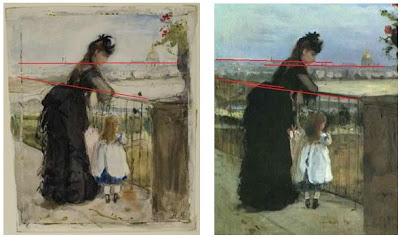

These kind of perspective mistakes happen all the time in Cezanne images. Cezanne described himself as having a “lazy eye” for such detail. But subsequent critics and subsequent generations of painters from Picasso on have embraced this kind of “mistake” on the theory that mismatched horizontals and diagonals create visual “tension” and interest. Cezanne fans, for instance, generally assume that Cezanne subconsciously mismatched his lines expressly to create more exciting images.

I’m not going to dwell on that business. I don’t think the oil version of this image is any more “exciting” than the watercolor because of the skewed left/right halves of the image. And I don’t believe Morisot created the skewed lines either consciously or unconsciously to add visual tension.

I think the mismatched perspective lines are simply the result of the different media, the different styles of painting.

The watercolor image was created by sketching a very light, loose image in graphite pencil. Then Morisot painted watercolor over the graphite. Then some touches of opaque gouache were applied in only a couple of areas. The important point is that the graphite under-drawing remained visible during the entire painting process, and even in the final image the drawing is still visible here and there. So the general perspective could be sketched in properly at the start and maintained to the finished image.

The oil painting probably started with a reasonably careful painted sketch which would have had the perspective lines matching. But in an oil painting the initial laying in of the sky and background usually obscures the under-drawing. Even if parts of the under-drawing remain visible, by the time the foreground figures are painted the under-drawing would be invisible. So tricky elements like the balcony railing and the horizon line have to be re-asserted by the painter. And when they are painted in, again, while the painter is concentrating on the foreground figures, it is easy to create what appears to be a visual match but which, when a straight-edge is applied, is seen to be skewed.

I think in this case it is just an artifact of the two media.

Watercolor is a wonderful medium, I think the most thoughtful of all media. Since watercolor is transparent, or translucent at least, the entire composition—and often the thinking of the painter—is always visible. To both the painter and the spectator.

The original thought really can’t get lost because the original thought is always right there, still visible, under the transparent applications of paint.

(Of course, there have been watercolor painters who painted so heavily, or with so much rubbing off/washing off and repainting, that the clarity of the medium was obscured. But that was a stylistic choice that pushed the medium to an extreme.)

Anyway, I love these images. And I think looking at little details like the skewed horizon and balcony lines underscores how trivial and irrelevant technical details are to images overall.

The power of the images is the composition. The conception of the composition.

Which brings up, to me, an interesting point.

I’d guess almost any art student, today, would have the skill-set necessary to create an image like either the watercolor or the oil version here. Both images are, as I’ve said, mostly carefully constructed silhouettes.

But how many painters—today—would conceive of such an image?

The images are so simple, yet they embody so much, they evoke so much.


So obviously I strongly suspect this whole episode can be seen in itself as a metaphor.


When I’ve done posts about the Frankenstein mythos I’ve stressed the dehumanization of the modern world, the notion that instead of building up a Frankenstein’s monster from spare parts, a whole human can be ripped apart and put back together into a monster.


The Princeton psychologist Julian Jaynes wrote of vestiges in the modern world of what he termed “diminished consciousness.” Modern incarnations of an ancient frame of mind. He characterized the diminished consciousness as having four aspects:


the collective cognitive imperative, or belief system, a culturally agreed-on expectancy or prescription which defines the particular form of a phenomenon and the roles to be acted out within that form;

an induction or formally ritualized procedure whose function is the narrowing of consciousness by focusing attention on a small range of preoccupations;

the trance itself, a response to both the preceding, characterized by a lessening of consciousness or its loss, the diminishing of the analog ‘I,’ or its loss, resulting in a role that is accepted, tolerated, or encouraged by the group; and

the archaic authorization to which the trance is directed or related to, usually a god, but sometimes a person who is accepted by the individual and his culture as an authority over the individual, and who by the collective cognitive imperative is prescribed to be responsible for controlling the trance state.


the General Bicameral Paradigm
from The Origin of Consciousness
in the Breakdown of the Bicameral Mind

by Julian Jaynes


Watercolor paintings, I think, are the most thoughtful of all media. Everything is right there. The reality. The response to the reality. The thinking about the response.

But I wonder: How much of this can even exist in our world?

And I wonder: How much of this can exist, now, in my world?


Monday, March 05, 2012

Memories Lost In The Canals Of Mars


Lost in the metonymy of puppets and painting
and songs moving, somehow, something like from east to west,
is this real, too, down here, this working, craft, quest to find
the illusion of pain, the grace of endless beauty?


I keep my good watercolor paints in an old crayon box. These are Winsor and Newton artist quality colors. I have a simple spectrum-based selection of colors. Winsor Red, Winsor Orange, Winsor Yellow, Winsor Green (blue shade), Winsor Blue (red shade) and Winsor Violet. I don’t have a Payne’s Gray. I do have both Indigo and Sepia, for mixed cool and warm grays. I also have an Ivory Black so I can mix other simple grays. And, just because I like the single pigment brown, I have a Raw Umber.

One reason I picked these particular colors is that the same, or very similar, pigments are available under one or another name in the Winsor and Newton student line of watercolors called “Cotman” watercolors. I have those as well simply because I get less nervous using the inexpensive paints than I do using the “artist” quality paints. And since I have almost identical pigments in both ranges, if I do something I like using the Cotman range, I know I will be able to do something similar with the more expensive artist-quality paints.

I’ve been thinking about watercolors a lot recently for a roundabout kind of reason—

A few years ago, I wrote a song for a woman. Back then I couldn’t play keyboards at all and I wrote the song on guitar.

Recently I was practicing on a keyboard and I realized that as I’ve been practicing various chord voicings on keyboard I have learned enough, and practiced enough, so that I can now play that song on keyboards. I mean the guitar song I had written for the woman.

It made me really happy to realize that. And to play it. I still can’t play it as fluently on keyboard as on guitar, but on keyboard I can play it differently, with harmony and melody, or with piano harmony and flute melody.

So I was thinking that kind of thing makes me really happy, having this song that brings back all my memories of someone.

But I’ve never been tempted to make sketches of people I know.

And I’ve been interested in photography for almost as long as I can remember and I have never had any urge at all to photograph people I know. In fact, in some obscure way, I’ve always felt something like the opposite urge—I’ve felt some kind of imperative not to photograph people I know, not to draw people I know.

I wonder why I like having songs that remind me of people, but not images?

I’ve never been tempted to draw or paint a self-portrait, but I don’t mind doing videos of me playing guitar and even trying to sing.

Anyway, so I’ve been wondering if I would feel more comfortable working with images of people I know if I put some kind of artificial construct around the person in the image. Maybe something like, “person X making a Vampirella face” or “person Y posing as the entomologist from ‘Them!’”

I don’t know. I had a lot of fun doing that “Vicki Over Her Shoulder” sketch, but I don’t really enjoy acrylics as much as watercolors. Or as much as just plain drawing for that matter. It’s been a long time since I’ve done a serious drawing or watercolor. I miss it.

And I’d really like somehow to discover a way to become as comfortable working with images of people as I am working with songs about people.

I feel I have some kind of mental block here. And writing about it, I’m hoping, will help me start to break through the mental block. Having songs that remind me of a person or a time or an event is a great source of pleasure to me. But it has always seemed to me that watercolors are the most thoughtful of all media. If songs are fun, it seems to me I should have even more fun, more satisfaction, from watercolor.

But when I introspect on this—or try to—I get this sense that there is something I’m not thinking of, some aspect of this that I haven’t yet been able to put into words, or into thoughts.

Anyway—again—so this post doesn’t have a lot of content to it. But this is something that is on my mind a lot.

I was just so happy over the weekend sitting around playing that song on keyboard that I had originally written on guitar.

I don’t know why I can’t do similar stuff with drawing and painting—making memories, enjoying memories.

I can do it with music, and writing. But I can’t do it with images. I don’t know why. I want to know why.

I’m working on this.


. . . . . . . . . . . . . . . . . . . . . . . . . . . . . . . . . . . . . . . . . .


This Woman From The Canals Of Mars


The Lost World Of Stacy And The Llama


An Unclear Story About Walking To Mars


Friday, March 02, 2012

The Scarf Would Be Like Dancing


I’ve never been tempted to play an accordion
and I’ve never been tempted to play a drum machine
but I can’t stop thinking about these technologies.

Modern synthesizer accordions have bellows
just like classic accordions. They breath, in and out.

An accordion player can take a breath and sing
just like a singer, shaping a note by breathing out.

A modern performance-oriented drum machine
has switches, knobs, sliders. And pads, like high-tech bongos,
and if, say, a woman percussionist was playing
with a long silk scarf tied to her wrist her hand motions
across the controls and up and down over the pads
would cause the scarf to swirl, fly up, twist, catch the light, shine.

And the performance of the scarf would be like dancing.

I’ve never been tempted to play an accordion
and I’ve never been tempted to play a drum machine.

But these technologies—They can sing and they can dance.

One time at a wedding I asked a woman to dance.

I told her I don’t know how to dance but I’d pretend.

When we were dancing, I said, “Am I doing okay?”

She smiled and said, “Everything is about pretending.”


British Women In The Bondage Of Love


Behind this tree, behind this very tree,
in this donut shop a British woman
is buying a donut. She has a scarf
wrapped a few times around her right forearm
and then tied in place gently with two knots.

He looked at her as he tied the two knots
and, smiling, said, without explanation,
“British women in the bondage of love.”

She looked at the scarf wrapped around her arm
and said, “It’s not very binding, is it?”

There is a small tree surrounded by cars
not too far from a busy donut shop.

The donut shop is open all night but
around midnight most of the cars are gone.

In the darkness at the edge of the lights
shining down on the empty parking lot
the small tree is almost invisible.

The night around the tree is very big
and farther away from the donut shop
the darkness is blacker still, binding shapes
into complete invisibility.

A napkin that somebody threw away
blows in the wind from the light to the dark
behind this tree, behind this very tree.


Thursday, March 01, 2012

Scribbles, In G Major


This is an actual manuscript page, in Beethoven’s hand, from his Violin and Piano Sonata, op. 96 in G major.


Yikes!

From what I have seen, this is not un-typical of a lot of music manuscripts.

The J.P. Morgan Library and Museum has a large collection of music manuscripts as written by well-known composers. It is pretty interesting to just look at the pages. I can’t imagine trying to perform from one. Of course, manuscripts aren’t really meant for performance, they’re intended I think to go to typesetters.

Thank heavens for typesetters, and, now, composition programs like Sibelius.

But looking at these handwritten pages is a remarkable experience.

As modern composers move to programs like Sibelius, students of music in the future won’t have many handwritten manuscripts to review. Future students still will get the music. But they won’t get something, whatever it is that these pages capture.


*


I have read that Chopin was most relaxed
sitting at a keyboard improvising
and the experience for listeners
was always reported as beautiful.

However, colleagues and friends of Chopin
who watched him craft an improvisation
into a form, structured and notated,
a finished piece, described the opposite—
He appeared practically tortured, choosing
between phrases constantly played, replayed,
started, stopped, changed and always played again.

The process at the start was beautiful
and would finish as beautiful music,
but the craft between improvisation
and the finished piece typeset on paper
was never described by the word ‘beauty.’

Music manuscripts capture the music
and something else, too—the scribbles themselves
are a kind of notation of structure,
structure that is not beautiful, not art,
but real, and getting down reality
into a visible form on paper
is something equal to beauty and art.

Computers clean up compositions now.

The pretty pages all computerized
push away scribbles. Whatever they are.


. . . . . . . . . . . . . . . . . . . . . . . . . . . . . . . . . . . . . . . . . .


‘Sibelius’ from AVID

*

Tricky Times

Chopin: Keyboards And Butterflies


Wednesday, February 29, 2012

Some Keyboard Notes


That’s a little phrase I made up recently. When I play it on keyboard I usually play it something like this.


Playing the melody is pretty easy, even with the sixteenth notes. And playing the chords (Em7, CM7, F#m7b5, D7) is pretty easy, too, even if you make the chord rhythm more interesting than this. But for me getting both of my hands to work together and keep time for this is, depending on my mood, either really fun or really challenging.

Right now this is my favorite kind of thing to practice with on keyboard. It’s interesting to my ears and it’s simple enough for me to get through. And it’s simple enough for me to move from key to key and practice the whole keyboard.

*

I like making up stuff to practice with rather than use scales or old songs. It’s so tempting (for me) to get technical or to live in the past that making up stuff is a kind of meditation drill to keep in the now and stay present (as new age types used to say).

Pete Townshend famously wrote the lyrics “I hope I die before I get old” (in “My Generation”) and for better and worse he managed to stay alive. But now he seems to completely live in the past, re-hashing his old triumphs and, too, being none-too-humble about it. I recently re-read this bit about Pete:


The song is about alienation, pollution, and a cold, heartless big brother—“only teenage wasteland.” It also features a duet between Townshend on ARP 2600 and Dave Arbus (formerly of East of Eden) on violin. Originally, Townshend had intended the song to be a twenty-piece orchestral and synthesizer work, but in the end he went with a demo track he had prerecorded in his own studio on the ARP 2600. As “blue eyes” himself puts it, “This definitive classic seventies rock song actually came from an indulgent experiment in electronic music.”


that excerpt is
from
Analog Days
by Trevor Pinch
and Pinch got
the Townshend quote
from
Behind Blue Eyes,”
by Geoffrey Giuliano
--they’re talking about

Baba O'Riley


One reason I’ve been thinking about this living in the past nonsense is because something frightening happened to me last weekend.

For reasons I don’t want to get into I watched an old video on YouTube. The video isn’t from the seventies, but rather one decade later and by people a generation or two younger than Townshend.

By some twist of fate, I actually remembered (I think) seeing the clip when it originally happened.

When I first saw it I could only think how ridiculous all the performers looked, how awful everything was—the music, the idiotic club dancing. Now, watching the clip decades down the road, the only thing I think is how sexy the two girls look, in white and red, and how sexy their dancing is.

Have a scare:


Tuesday, February 28, 2012

Vanity Fair Magazine In A Book Store Café


Yesterday I went to a library
and then I walked through an arts and crafts store
and then I walked over to the building
where there used to be a Borders book store.

It’s empty now but it looks like someone
is remodeling the interior
to open as some new kind of business.

Looking inside where there used to be books
I didn’t miss the Borders store at all.

The only book store that I’ve ever missed
is a used book store up on the north side.

I don’t get up north much anymore so
I don’t even know if it is still there
but I used to live just a few blocks east
so I’d visit it once or twice a week.

All they sold were used books—no comic books
or movies or CDs or magazines
or any of the other worthless junk
used book stores always seem to sell these days.

Of all the book stores I’ve ever been in
that used book store from up on the north side
had the most respect for the books it sold.

Borders used to sell a lot of junk too.

Now they’re gone and they don’t sell anything.

Walking through the nearby arts and crafts store
in the paint section I met a woman
I know looking at watercolor paints.

She told me she was starting to work through
an instructional watercolor book
and the author suggested she purchase
a brown pigment but didn’t say which one.

“What do you think?” she asked me. “Raw Umber?
Burnt Umber? Sepia? Is one the best?”

I shook my head. “They’re all pretty,” I said.
I asked her, “Do you ever use Payne’s Gray?”

“I love Payne’s Gray,” she said. “And the book said
I should use Payne’s Gray to darken colors.”

I said, “Consider the Sepia then.
Sepia is a mixture like Payne’s Gray
but instead of being cool it is warm.
Payne’s Gray is blue mixed with a little black.
Sepia is brown and a little black.”

“I think Payne’s Gray is beautiful,” she said.
“I’ll give Sepia a try. I’m so glad
we bumped into each other. How do you
know these little details about the paints?”

I said, “I read all the little writing
in the tiny print on the paint labels.”

“You would!” she said. “Thank you for helping out.”

She used to go to Borders all the time
and sit in that little café they had
where you could read magazines and drink tea.

The last time that I’d met her in Borders
she’d been sitting in that little café
reading a Vanity Fair magazine.


. . . . . . . . . . . . . . . . . . . . . . . . . . . . . . . . . . . . . . . . . .


Fluorescent Lights On A Book Of Shadows


Things Libraries Throw Away


Monday, February 27, 2012

Talk Outside The Donut Shop


Leaves change from green to red and then fall off.

The donut shop always keeps its color.

The trees talk about the donut shop but
the donut shop doesn’t notice the trees.

The donut shop has cars and customers
and coffee and donuts to talk about
and there’s green in the donut shop all year
because customers park cars in the lot
and go inside and money changes hands.

I saw grade school kids leave the donut shop.

They were on lunch break from a nearby school,
walking back, talking and eating donuts.

Between big bites of donut, one boy asked,
“Did you guys study puberty today
in Family Values class with Miss Stanley?”

Boys and girls, donuts in hand, all yelled, “Yeah!”

Adults drive to the donut shop. Kids walk.

The donut shop doesn’t notice the trees
but the trees talk about the donut shop.

I wonder if that one tree is asking,
“Did any of those kids with the donuts
ever fly a kite that got tangled up
in your branches? Or a model airplane?”

And are the other trees laughing, saying,
“When was the last time anybody saw
kids flying kites or flying model planes?”


. . . . . . . . . . . . . . . . . . . . . . . . . . . . . . . . . . . . . . . . . .


Maggie And The Fish Head


What Is Electric Sugar?


The Book Of Love In The City Of The Dead


The Time Of The Dinosaurs


Friday, February 24, 2012

Naming Things: Hippie Girls And Monsters


The monsters do their best
Ripping apart the world
To keep us together


Look— That’s my Sony Discman. It still works.


I was listening to Joni Mitchell
from a CD in my Sony Discman
while watching “It Came from Beneath the Sea”
from a DVD but the Sony thing
that plays DVDs isn’t a ‘Discman’
in fact it doesn’t have a name at all
it just says ‘Sony DVD Player.’


I wonder why Sony stopped naming things?

That’s Joni Mitchell’s “Court and Spark” CD
in the picture with my Sony Discman.

The movie and the album both have names
and all the songs on the album have names
but the giant octopus wasn’t named
like Godzilla or Mothra or King Kong.

Seems like everything’s better with a name.

Anyway so the giant octopus
was wrecking San Francisco’s waterfront
and Joni Mitchell was singing folk songs
and I thought that made a better soundtrack
for the movie than scientists talking
to Navy tough guys about torpedoes.

Nowadays the Navy has torpedoes
that modify their boundary layer
so they can travel under the water
at many hundreds of miles per hour.

The music business doesn’t mass-market
hippie girls singing folk songs any more.

I was listening to Joni Mitchell
while watching “It Came from Beneath the Sea” —
To me that’s like a documentary.


Thursday, February 23, 2012

She Asked, “Why Are You Looking...”


. . . . . . . . . . . . . . . . . . . . . . . . . . . . . . . . . . . . . . . . . . . . . . . .

There’s an interesting thing going on in the sky lately and it’s one of those things you don’t need a telescope to observe.

If you look to the southwest right after sundown, the brightest star there, the very bright white star, isn’t a star at all, it is the planet Venus.

A few hours later, if you look to the southeast, the very bright red-orange star also isn’t a star at all, it is the planet Mars.

Venus and Mars are the two planets closest to the Earth. Venus is the next planet nearer to the Sun than the Earth, and Mars is the next planet farther from the Sun than the Earth.

The view in the sky now is one of those situations where the positions of the astronomical objects aren’t tricks of perspective or alignment but are exactly what they look like. As the Earth turns, when an observer on Earth rotates away from the Sun, they see Venus just off to the side, so to speak. Then as the Earth continues to rotate and the same observer gets a view of deep space away from the Sun, Mars becomes visible.

In the southwest after sundown, the second bright star in the sky, the bright star near Venus, isn’t a star as well, it’s the planet Jupiter. Although Jupiter to the eye appears close to Venus, that is simply a trick of alignment and perspective. Jupiter in the solar system is the next planet out from Mars, so really Jupiter is very far away from Venus.

I always ask myself: What’s the difference between knowing this stuff and not knowing it?

Does it matter in any way?

(When Paul McCartney wrote the beautiful two-part song “Venus and Mars” he didn’t know those planets were closest to the Earth. He just liked the way the words sounded together. But later when he learned the astronomy bit, he thought it made the song more interesting and made everything fit nicely.)


*


I need a new pair of pants and new shoes.
I have two pairs of jeans. One has a hole.
And both my pairs of walking shoes have holes.

I’ve known people who cut holes in their jeans.

I pointed and asked, “Did you cut that hole,
or was it in the pants when you bought them,
or did it happen accidentally?”

She asked, “Why are you looking at my thighs?”

I said, “You have a hole right by your crotch.”

She didn’t say anything, she just laughed.

But like science I investigated
and discovered she cut the hole herself.

I walk a lot and get holes in my clothes.
It’s wear and tear, it’s not calculation
toward a fashion statement of principle.

Venus is white and Mars is orange-red.

Science is what we do inside our head.


. . . . . . . . . . . . . . . . . . . . . . . . . . . . . . . . . . . . . . . . . . . .


*


Dinosaur By Moonlight: A Puppet Show


Planetary Colors And The Grail Quest


Moon Dust In Waltz Time


Wednesday, February 22, 2012

Notes From My Vampirella Expedition


I don’t often go to comic book shops
but now and then I do. I like writing
and I like drawing. Now corporations
seem to define the entire comics scene
even the so-called alternative press
but sometimes I go to comic book shops
just to see what’s new. Sometimes I look for
something old. The last time I visited
a comic book shop someone had told me
there was a Vampirella re-release
with the original Frazetta art.
I couldn’t find it. The owner helped look.
He couldn’t find it either but did find
“Crimson Chronicles—One,” the re-release
of the original Vampirella
stories that has all the inside artwork
but no covers. Not the Frazetta art.
I didn’t really want it but after
the owner was nice enough to help look
I bought it anyway to be polite.
The artwork’s still better than today’s stuff
even though it wasn’t Frazetta’s work.

At one point when I was looking around
the woman who works there was shelving books.
Walking in front of me, she dropped a book.
She kneeled down to pick it up and a space
opened up between her jeans and her back
and presented a sexy, shadowed scene
looking down at her butt and lingerie.

I wondered: Did the woman drop the book
just so she could kneel down in front of me
and show off a bit of her pretty butt?

The very next day—the very next day—
I was buying groceries and in line
I knew the woman in front of me but
she was on her phone, I couldn’t say hi.
The line wasn’t moving. She decided
to try another check-out lane. As she
stepped away, she dropped something and kneeled down
to pick up whatever it was. A space
opened up between her jeans and her back
and presented a sexy, shadowed scene
looking down at her butt and lingerie.

I wondered: What the hell is going on?
In this Jungian synchronicity?
Did she drop whatever it was she dropped
just so she could kneel down in front of me
and show off a bit of her pretty butt?

Anyway, I never got a copy
of Frazetta’s Vampirella cover.
A lot of stuff you see today isn’t
up to the standard set by Frazetta.
But you can’t stop looking around. Sometimes
you see stuff that’s better than Frazetta.


Tuesday, February 21, 2012

“Britney To Razor Blades”


  1. A short course in forgetting chemistry

  2. How to count in oil and stone

  3. The mouldy materia prima

  4. How do substances occupy the mind?

  5. Coagulating, cohobating, macerating, reverberating

  6. The studio as a kind of psychosis

  7. Steplessness

  8. The beautiful reddish light of the philosopher’s stone

  9. Last words


Chapter titles
from “What Painting Is”
by James Elkins


This afternoon I was waiting in line
in a store to pay for some Benadryl.

When I drink too much Red Bull the sugar
and caffeine cause my sinuses to ache.

It must be like an allergy because
Benadryl helps get me back to normal.

The pills, and staying away from Red Bull.

This afternoon I was waiting in line
in a store and the sound system clicked in
as a manager made an announcement.

“Britney to razor blades,” a voice announced.

“Britney to razor blades,” it repeated,
“there’s a customer who needs assistance.”

I looked at the other people in line
and said, “‘Britney to razor blades’—that sounds
like a song title or gossip headline.”

People smiled. A woman said, “If it was
a gossip headline I’d read the story.”

James Elkins taught at the Art Institute
of Chicago’s school when he wrote the book,
“What Painting Is.” He taught art history,
theory and criticism, and the book
is an interesting comparison
of painting to alchemy. James Elkins
is a painter, writer and alchemist.

This afternoon I was waiting in line
in a store. The wait became something else.


Monday, February 20, 2012

I Don’t Know If People Dancing Care


“Mother,” the girl interrupted, “listen to me. You remember that book he sent me from Germany? You know—those German poems. What’d I do with it? I’ve been
racking my—”

“You have it.”

“Are you sure?” said the girl.

“Certainly. That is, I have it. It’s in Freddy’s room. You left it here and I didn’t have room for it in the— Why? Does he want it?”

“No. Only, he asked me about it, when we were driving down. He wanted to know if I’d read it.”

“It was in German!”

“Yes, dear. That doesn’t make any difference,” said the girl, crossing her legs. “He said that the poems happen to be written by the only great poet of the century. He said I should’ve bought a translation or something. Or learned the language, if you please.”

“Awful. Awful. It’s sad, actually, is what it is.”


from “A Perfect Day for Bananafish”
by J. D. Salinger


“Come, let Us go down and there confuse their language, that they may not understand one another’s speech.”

So the Lord scattered them abroad from there over the face of all the earth, and they ceased building the city.

Therefore its name is called Babel, because there the Lord confused the language of all the earth; and from there the Lord scattered them abroad over the face of all the earth.


Genesis 11:7-9


In an internet sort of way over the weekend
I discussed electronica with a musician
from Finland. He spoke English, I didn’t try Finnish.

Percussion synthesizers can generate a groove
and other synthesizers in sync can add color
in the form of cool sounds or gritty sounds or wild sounds
and a musician can adjust faders and twist dials
and slide a finger along a ribbon controller
and press buttons to manipulate the groove and sounds.

People dance to this. The musician has made music
and the process didn’t use even one instrument.

It didn’t use, that is, a classical instrument
and since many synthesizers do not use samples
recorded from a classical instrument playing
but instead generate sounds directly from waveforms
people aren’t dancing to classical instruments.

The theory is buttons, faders, dials and controllers
are instruments now. The network of synthesizers
is the instrument now. Manipulating programs
is the way a musician plays an instrument now.

But are these people musicians? Or operators?

That’s the debate. I don’t know if people dancing care
if there’s a fist-fight going on in the back alley
over the labels ‘musician’ and ‘operator.’

I do know Paul Shaffer got pissed off at Britney Spears
when Britney said Paul was David Letterman’s “DJ.”

I discussed electronica with a musician
from Finland. We typed the words into our computers
and the process didn’t require us to move our lips.


Friday, February 17, 2012

Serious Thoughts With The Lights Off And On


One night under a bright full Moon people enjoying an evening out were eating dinner in a club. Three musicians were on a bandstand getting ready for their set. Suddenly the front window shattered and a werewolf leaped into the club. The werewolf snarled and howled and slashed at the air with its claws. Everyone in the club ran to the back where the owner was trying to find the key to open the alley door.

On the bandstand, the piano player said, “Don’t worry. Music has charms that sooth the savage breast. I will save us.” The piano player began playing beautiful classical music, the opening bars of the ‘Nocturne in E flat major’ by Chopin. The werewolf howled and leaped onto the bandstand. Grabbing a leg of the piano, the werewolf hurled the piano off the bandstand and the instrument crashed against the floor smashing to pieces. The piano player ran from the stage and huddled in the crowd at the back of the club.

On the bandstand, the guitar player said, “Don’t worry. I’ll play a modern piece that is loved all over the world.” The guitar player began playing the guitar intro to ‘Stairway to Heaven.’ The werewolf snarled and grabbed the neck of the guitar, wrenching the instrument away from the musician and smashing the guitar against the bandstand. The guitar player ran and huddled in the back with everyone else.

On the bandstand, the third musician, a woman with a flute, said nothing but just began playing. The werewolf snarled, howled and slashed at the air in front of him, then turned and leaped off the bandstand and ran out of the club through the shattered front window.

The club owner walked onto the bandstand. “That was amazing,” the club owner said to the woman with the flute. “That was the bravest thing I’ve ever seen in my life.”

The woman with the flute shrugged. “It was nothing, really,” she said. “I just started playing that Paul Desmond-Dave Brubeck thing, ‘Take Five.’ Everyone always runs away when they hear a flute playing jazz.”


“If you were going to film that
or animate that,” she asked me,
“what kind of werewolf would you use?
The classic Lon Chaney, Jr.,
kind of wolfman, or the modern
freaky animal kind of thing?”

“I would go with the classic look,
like Lon Chaney, Jr.,” I said.
“I like the human man-beast look,
where the creature still has torn bits
of clothing on him here and there.
The werewolf that scared me the most
was the Oliver Reed creature
in the film, ‘Curse of the Werewolf.’
Even though he was practically
well-dressed as a werewolf he still
seemed the most savage and vicious.
I think modern versions that use
a freaky animal werewolf
undercut the terror because
animals act like animals
so there’s nothing really shocking
about a big wolf-like creature
eating people. But a human,
that is, the classic man-beast look,
a werewolf where you’re reminded
that the creature is part human,
that is shocking, that is scary,
grabbing people and eating them.”

She said, “You’ve really thought this through.
You’ve given this serious thought.”

For a moment I said nothing.
I looked at her and then looked down.
“Maybe,” I said, “I have been forced
to think it through. Maybe the Moon—”
I lowered my voice and whispered
“—changes me. I become a beast.
Maybe this monster stuff is real.
There are things that can’t be controlled.”

I stopped talking, still looking down.
Then I looked up, quickly, growling,
and pretended to snap at her.

She screamed, all wide-eyed and shrieking
and tumbled sideways off her chair.

I caught her and, laughing, hugged her
and got her steady on her chair.

She made two fists but didn’t swing,
just sat shaking, red in the face.
She said, almost growling herself,
“I cannot believe you got me.
I’ve looked at the full Moon with you.
I know you aren’t a werewolf.
Am I a little girl, a child,
getting scared by bedtime stories?
I cannot believe you got me.”

“Bedtime stories?” I asked. “Are you
thinking it’s time to go to bed?”

“No, I’m not” she said. “In fact now
I’m thinking I want some Red Bull.”
She stood and walked to the kitchen.
“I’m taking a whole can,” she said.
“Do you want a can for yourself?”

I said, “The caffeine might change me.”

On the way back from the kitchen
she switched on all the ceiling lights.

“What’s this?” I asked. “Are you never
going to go to bed again?”

“I’m thinking about it,” she yelled.
“I’m giving it serious thought.”


. . . . . . . . . . . . . . . . . . . . . . . . . . . . . . . . . . . . . . . . . . . . . . . .


*


Before And After ‘Nuts Do Hop’—A Valentine


Landscape With Tiny Dirigibles. Or Not.


Pamela At The Doorway To Atlantis


Thursday, February 16, 2012

More Night Than Just The Stars


We were both silent for a while; and as I looked towards the window I saw the first dim streak of the coming dawn. There seemed a strange stillness over everything; but as I listened I heard as if from down below in the valley the howling of many wolves. The Count’s eyes gleamed, and he said:--

“Listen to them—the children of the night. What music they make!”


from Dracula
by Bram Stoker


Music —
Is something in the music
The way music’s in the night?

. . . . . . . . . . . . . . . . . . . . . . . . . . . . . . . . . . . . . . . . . .


Under the stars on a summer evening
a small telescope set up in the grass
reveals to the astronomer more night
than just the stars. Moths and flying beetles
land and rest on the smooth telescope tube.
Spiders climb up the tripod legs, and down
thin strands of silk if there are trees nearby.
Leaf hoppers, flies, mosquitoes—I’ve even
observed walking sticks and praying mantis
gathering around either the science
or body warmth of the astronomer.

The stars come out, too, on winter evenings
but there are no bugs, then, to share the night.
Bug metabolism, the chemistry,
doesn’t work as well when the weather’s cold.
But the night’s still there. The stars are still there.
And the telescope and astronomer.
Nature, so they say, abhors a vacuum.
I’ve always wondered why evolution
didn’t chance upon a mechanism
comfortable in the winter’s cold dark
as insects are on a summer’s warm night.

An eye augmented by a telescope
sees invisible things up in the sky—
Some stars are double. Some ‘stars’ are planets
circled by moons or enshrouded by clouds.
And some empty spaces between the stars
aren’t empty at all but make strange shapes
as interstellar gas glows in the void.
I’ve always wondered if a winter’s night
around an astronomer is empty.
What might the right instrument reveal? Ghosts?
Lost myths? Invisible eyes watching us?


Wednesday, February 15, 2012

The Question For Frankenstein’s Friend


The monster continued to utter wild and incoherent self-reproaches. At length I gathered resolution to address him in a pause of the tempest of his passion: “Your repentance,” I said, “is now superfluous. If you had listened to the voice of conscience, and heeded the stings of remorse, before you had urged your diabolical vengeance to this extremity, Frankenstein would yet have lived.”

“And do you dream?” said the daemon.


from Frankenstein
by Mary Shelley


So Mary Shelley possibly with help
from her poet boyfriend wrote a novel
and at the very climax of the book
the monster describes itself as alone
more alone even than Satan himself
who has fallen angels for companions
and the monster asks its creator’s friend
by Frankenstein’s body, “And do you dream?”

Frankenstein’s friend makes an attempt to state
the context he sees around the monster
but the monster has a soliloquy
to deliver and the ability
to define and describe its own context
and the monster with its creator’s friend
is still alone and delivers its speech
and is still alone and still a monster.

What would Frankenstein’s friend if asked today
“And do you dream?” even attempt to state—
“I like when the TV flashes bright lights
and I like when the TV yells at me” ?—

to put a context around the monster
Mary Shelley never could have foreseen
even if her poet boyfriend had helped
even if the lonely monster could care?


Tuesday, February 14, 2012

Before And After ‘Nuts Do Hop’—A Valentine


I stopped what I was doing
and scribbled in my notebook.

SHOUT POND
NO PUSH DOT

She stopped what she was doing
and read what I had written.

“Shout pond?” she asked. “No push dot?”

I smiled and she made a face.

“Okay,” she said. “I give up.”

“Come on,” I said. “Try harder.”

The face she made got harder.

“Okay,” I said. “Donut shop.
They’re ‘donut shop’ anagrams.”

Her face didn’t change at all.

She looked from me to the words
then she sighed and closed her eyes
and her face became softer.

“I cannot believe,” she said,
“I’m going to say this, but—
‘Nuts do hop.’ Are you happy?”

I wrote it in my notebook.

NUTS DO HOP

I said, “That is very good!
See, you’re getting good at this!”

She put her fingers over
her closed eyes and shook her head.

She asked, “What have I become?”

I said, “Even more sexy.”

She made an eye-rolling face
but I tackled her before
the expression settled in.

By our rules that means I won.


. . . . . . . . . . . . . . . . . . . . . . . . . . . . . . . . . . . . . .. . . . . . .


Pamela At The Doorway To Atlantis


Landscape With Tiny Dirigibles. Or Not.


Hen Politics, And Passages Between Worlds


Monday, February 13, 2012

Vicki Over Her Shoulder: A Sketch


She said, “I don’t know that you’ve captured the real me.
Is that really how you see me? Pink and orange?”

“It’s just an acrylic sketch,” I said. “I’m playing
with shapes. Playing with brushes. And playing with you.”

“You’ve given it a name,” she said. “And you started
by doing a rough drawing on an index card.
Ten shapes? Is that all it takes to paint me? Ten shapes?”

“I was playing with shapes,” I said. “But I can see
I made one mistake that wrecks this as a likeness.”

“What’s that?” she asked. “You mean the pumpkin orange hair?”

“In this acrylic sketch,” I said, “your mouth is closed.”

“Oh shut up!” she said. She pressed her lips together
to keep from smiling, but when she saw me staring
at the shape her lips made she opened her mouth wide
and stuck her tongue out at me. Then she turned, quickly,
so that her hair bounced brightly as she walked away.

She didn’t look back at me over her shoulder
but that’s okay. In the little painting, she does.


. . . . . . . . . . . . . . . . . . . . . . . . . . . . . . . . . . . . . . . . . .


I’m trying to experiment
with ways to get a handle
on doing stuff like this
that specifically avoid
anything ‘photographic.’

This is the index card version:


*


An Up-To-Date Vicki Inventory


Dinosaurs And Robots And Vicki’s Smile


The Best Reason To Study Astrophysics


Repurposing Vicki


This Woman From The Canals Of Mars


Jeanne Hébuterne — Art As A Grail


Friday, February 10, 2012

Orson Welles And Miley Cyrus K-i-s-s-i-n-g


“Every radio program tries
to be more dramatic than life as every play
tries to be more dramatic than life and
every movie, not less so.”


Orson Welles and Miley Cyrus
Sitting in a tree
Orson Welles and Miley Cyrus
K-i-s-s-i-n-g

. . . . . . . . . . . . . . . . . . . . . . . . . . . . . . . . . . . . . . . . . .


I first played this melody, these arpeggios,
on guitar where grabbing the third an octave up
isn’t too hard because of the way strings are tuned.

On keyboard playing this with one hand is a stretch,
but if you pivot fast on your index finger
and reset fast for the next root it’s possible.

On keyboard you can play the root with your left hand
making it the treble note of a larger chord,
and the rest of the arpeggio is easy
for the right hand and there’s no rushing to reset.

On keyboard, too, of course, there is extra drama
in playing the root in a low chord’s treble note
and then still playing this as written right-handed
with the necessary pivoting and shifting.

When you add in Orson Welles and Miley Cyrus,
I mean when you sing along with your own playing,
this little five-bar tune becomes larger than life.

What a movie that would be—A young Orson Welles
brought back by extraordinary special effects
in a romance with Miley Cyrus as herself
and a larger-than-life jazz soundtrack about love.

What a wonderful scene that would be—Where Orson
explains to Miley that entertainment should be
more dramatic than life, not less so. She would nod,
swoon and they’d kiss. It would be a synthetic kiss
because he would be only a special effect
but with a jazz soundtrack bringing it all to life
it would be more dramatic than life, not less so.

Orson Welles and Miley Cyrus
Sitting in a tree
Orson Welles and Miley Cyrus
K-i-s-s-i-n-g


The thought is more dramatic than life, not less so.


. . . . . . . . . . . . . . . . . . . . . . . . . . . . . . . . . . . . . . . . . .


Orson Welles at Wikipedia


*


Moon Dust In Waltz Time


You Damn Punk Kids


Dracula, The Wolfman And Miley Cyrus


Women From The Ancient Cities