Tuesday, October 09, 2007

Cool Old Things Versus Cool Modern Things


Recently I’ve been thinking about cool old things versus cool modern things. Specifically, I’ve been thinking about binoculars and telescopes.

The coolest binoculars on the market right now are Canon’s 18x50 IS binoculars. They require batteries. They need batteries because although 18x is kind of high power for that aperture, the binoculars compensate for the power by using dynamic image stabilization mechanisms. When you look at something and focus, you then press the IS button and high-tech micro-electronics apply tiny motions to the prisms inside the binoculars to keep the view you see rock-steady. Every user report I’ve read says the technology works great and has completely eliminated the need for a tripod when using the binoculars for astronomy. That’s pretty cool.

The coolest telescopes on the market right now are in Meade’s RCX line. They need to be plugged in. They require power because not only does the telescope mount use electric motors to move the telescope around in altitude and azimuth, but the telescope itself uses micro-electronics to shift the secondary mirror forward and back to focus the telescope. Since everything is computerized—the mount uses GPS signals to help calibrate its GOTO mechanism—even collimating the mirrors is automated. With everything under computer control, astrophotographers can define and return to precise image settings from session to session. That’s pretty cool.

This is all techno-sexy and if I had a lot of disposable income I’d probably be a happy owner of the high-tech binoculars and telescopes. But they are certainly different from what I’m using now.

The telescope I’m using now is the same telescope my parents purchased for me back in 1968 or ’69. It was the first really good thing I ever owned. Optical systems built around lenses don’t really degrade if you refrain from using them to do things like hitting people on the head. My telescope is generally as good today as it was almost forty years ago. Of course, modern refractors are better color-corrected and modern eye pieces are better designed. But my telescope works as well today as when I was a kid. In fact, the telescopes works better, since I’m more familiar with the sky and can operate the telescope better.

The binoculars I’m using now are about thirty-five years old. My dad bought them when he and I were on our way to Wisconsin on a fishing trip. Like telescopes, if you don’t use binoculars to hit someone over the head, there’s little that will degrade over time. They still function great.

But what about modern binoculars and telescopes?

There is an acronym close to the heart of everyone who has worked in the computer business: MTBF   The letters stand for “mean time between failure.” Computers always break down. There’s never a question that computers will break down. Computer professionals distinguish between good and bad systems, however, by their MTBF. Bad systems will break down more often and more quickly than good systems.

Canon’s binoculars and Meade’s telescopes are built around microelectronics. There’s no question the equipment will fail. The question is, how long will it function before it fails? In the product documentation I’ve read the companies don’t address this.

A second, related, issue is, what happens ten years from now? Twenty years from now? Will the micro-electronic components at the heart of these high tech systems still be manufactured? Will ‘repair’ even be an option or will people simply be advised to purchase new equipment?

And is that a bad thing?

I don’t know.

I wrote six novels using the original Macintosh and its follow-on computer models. That hardware and software architecture doesn’t exist any more. For the most part, it is simply easier for me to use printouts and re-type the manuscripts than it is for me to track down some specialty shop that takes old disks and reads them, recognizes old software formats and translates them.

Computers make almost everything easier. They transform almost everything that once was regarded as a kind of chore into something like a kind of pleasure. The price for this transformation is constant change. Disconnection from the past. Not only constant residence in the present, but constant embrace of what is coming.

Is that a bad thing?

I don’t know.

I type fast and I make little corrections as I go so I don’t really mind re-typing old manuscripts. I enjoy high tech stuff so I don’t mind the constant turn-over of equipment.

But I’m aware this is a very different world we’ve created, very different than the world thousands of previous generations of human beings have lived in and I wonder if the techno-sexy consequences all will be benign.




Monday, October 08, 2007

“Boozing Angelina Collapses!” *


Knock, knock!

Who’s there?


‘Boozing Angelina Collapses!’

‘Boozing Angelina Collapses!’ who?


‘Boozing Angelina Collapses!’
And a thousand violins begin to play
Or it might be the sound of your ‘Hello’
This music I hear
I get misty
The moment you’re near...


---------------------------------------------------

* The title refers to a story in the 10/15 issue of the National Enquirer about Angelina Jolie. It’s not about my friend Angie. Angie’s full name is Angeline. And Angeline has told me repeatedly that when she goes out with Brad Pitt she never gets falling-down drunk.


Friday, October 05, 2007

The Almost, Sort Of, Kinda Wisdom Of Blake Edwards


So a few years ago my friend Derrick went to Los Angeles to make it as a screenwriter. He didn’t even last two years out there. He came back in a year and a half without a satchel full of unproduced screenplays and without an agent. He did bring back, however, two Hollywood stories.


The first Hollywood story involves a beautiful actress.

Derrick had gotten a job working at a store that sold furniture. One day Raquel Welch bought a small coffee table and Derrick got the job of carrying out the table to her SUV. He said Raquel Welch in real life was very pretty, very nice and gave him a twenty dollar tip.

I said, “Yeah, well, was she wearing a bra? Did you see her breasts?”

Derrick said, “She was furniture shopping and I was carrying furniture out to her SUV. She wasn’t dressed for club-hopping and I wasn’t looking at her breasts!”

I said, “Oh, Derrick, you were in Los Angeles!”


His second Hollywood story involves a famous director.

One night Derrick was out taking an evening walk. He didn’t remember what street he was on. (It’s always a bad sign when a writer doesn’t remember [or won’t make up!] the pointless details that flesh-out a story.) At some point Derrick looked up and saw Blake Edwards walking toward him. Derrick introduced himself and told Edwards how much he admired his films. Blake Edwards made some strange hand gesture and then said something amusing and cutting which illuminated the very heart of the movie business. Unfortunately Edwards apparently had been drinking that evening and his speech was so halting, his pronunciation so slurred, that Derrick didn’t understand a single word of what Edwards said. Then Edwards just nodded and walked off into the beautiful Los Angeles night.

I said, “That’s a cool story for folks who know who Blake Edwards is. But is that the way you’re going to tell it?”

Derrick said, “That’s what happened!”

I said, “Yeah, well, but it’s a Hollywood story.”

Derrick told me that’s the way it happened and that’s the way he was going to tell it.


It the grand tradition of Hollywood stories, however, whenever I tell the story about my friend meeting Blake Edwards, in normal conversation—normal, that is, unlike a heart-to-heart blog posting—I usually tell it like this:


Yes, a friend of mine went out to Hollywood to be a screenwriter. He didn’t have much luck, though. He did have a cool brush-with-greatness while he was out there.

One evening he was walking along Hollywood Boulevard, looking at all the names and stars in the pavement of the Walk of Fame. At one point he looked up and there, walking right toward him, were Julie Andrews and Blake Edwards! My friend introduced himself and told them how much he loved their work. He told them that he was trying to make it as a screenwriter, he wanted to write films. They wished him luck. Julie Andrews said show business was all about persistence, about not letting the grind get you down. Then Blake Edwards pointed his index finger at my friend and said, “Let me tell you something about the movie business you should always remember. Really great movies don’t get made because of the skills and passions of a team of filmmakers. Really great movies get made in spite of the so-called skills and so-called passions of a team of filmmakers!” Julie Andrews grimaced and said, “Oh, Blake!” and hit him on the shoulder. My friend laughed, and said, “That’s very good!” Julie Andrews and Blake Edwards both wished my friend luck again, and then continued their evening walk. My friend shook his head, smiling. He was thinking, ‘Wow, that old Kinks song is right. You really do see the stars when you walk down Hollywood Boulevard!’


Raquel Welch Wiki


Blake Edwards Wiki


Thursday, October 04, 2007

Dead Monkeys. Swimming Pools. Movie Stars.


Almost every group of young friends sooner or later will spend some time voting among themselves, deciding who is most-likely-to-succeed, who is most-likely-to-be-divorced-before-thirty, who is most-likely-to-spend-time-in-prison. Those kinds of things.

I did that with my friends in high school. Most of us were show business wannabees of one kind or another. I wanted to be a novelist. My friend Derrick wanted to be a screenwriter. Martha wanted to be a writer-producer-director-performer. Et cetera. One afternoon about a dozen of us sat around in an abandoned chapel (I went to a Catholic high school) and we decided that everyone would get voted something.

So, Martha got voted most likely to have her own TV show. Phil got voted most likely to have his own comic strip. Derrick got voted most likely to make a movie.

Everyone got voted something.

I’ve never attended any of my high school reunions so I can’t compare how my group of friends actually turned out compared to the votes. I do know, however, that from among my friends I am the only one who hasn’t (yet?) made the pilgrimage to Los Angeles.

Tomorrow I’ll tell a story about my friend Derrick’s eighteen month excursion to Hollywood to be a screenwriter.

I’ve always remembered Tom Snyder saying that Los Angeles is a wonderful, wonderful city to live in—if you have a job. He said that the better your job, the more wonderful Los Angeles is to live in. If you don’t have a job, Los Angeles isn’t so hot.

I’ve always been waiting for some set of circumstances to transpire so that I could go to Los Angeles without having to put an open guitar case on the sidewalk in front of me and depend on my Neil Young-like guitar and voice skills [!] for making a living.

Yeah. So, everyone was voted something.

I was voted most likely to end up floating face down in a swimming pool.

I just know that when I do go to Los Angeles someone like, say, Jamie Lee Curtis will mistake me for the guy who is supposed to take away her dead monkey.

I’m not fighting my destiny. Not really. I’ll go to Los Angeles. I’m even kind of in a perverse way looking forward to going there. But there are just one or two things I still want to do before I go out there and check-in to the swimming pool with my name on it.


Sunset Boulevard Wiki


Wednesday, October 03, 2007

“Let Me Tell You Something About Los Angeles”


I’m working on a story now and at one point in the story a young man offers to take a young woman to Los Angeles. The young woman laughs, and says, “Is that an invitation or a threat?” The young man then says:


“Let me tell you something about Los Angeles. Los Angeles is different from every other city in America. Los Angeles is special because of the people in Los Angeles. Unlike every other city in America the people in Los Angeles are in Los Angeles because they want to be in Los Angeles. They’re not there because they were born there. Nobody was born in Los Angeles. They’re not there because someone they love is there. Nobody loves anybody in Los Angeles. They’re not there because some magazine singled out the city for its cool jobs. All the jobs suck in Los Angeles. People are in Los Angeles because they choose to be there. Maybe they want to be part of what they think is the entertainment business. Maybe they want to be part of what they think is the party scene. Maybe they want to run a criminal enterprise built around the entertainment business or the party scene. Hell. Maybe all those things. Whatever. But they choose Los Angeles. People are in Los Angeles because they want to be in Los Angeles. That’s why the city is different. That’s why the city is special. That’s why the city is magic.”


Tuesday, October 02, 2007

Sea Monkey Update, Fall 2007


About the only downside to keeping Sea Monkeys is that—to use one of my favorite phrases—in the fullness of time their little Ocean Zoo aquarium gets to looking very grungy. The bottom becomes covered with dead Sea Monkeys and cast off shells and uneaten food. The walls becomes covered with whatever kind of algae manages to grow in such salty water. It’s possible to scrap the walls a little, but then the stuff just falls to the bottom and joins that mess and the clean streaks make the rest of the walls look even dirtier. And it’s possible to use the official Sea Monkey plastic siphon (yes, I have one) to siphon away the mess from the bottom, but then you have to replace the water with equally salty water and none of their documentation ever actually spells out the salinity level.

Just over a year ago I thought I’d worked out a solution to the dirty Ocean Zoo problem.

The official Sea Monkey handbook says that if you let the water evaporate completely, all the salts will remain, dried as crystals on the inside of the container. You can just re-fill the container with water and Sea Monkey eggs—which by their nature survive dry spells—will hatch and a whole new generation will be born.

I decided I’d try out that procedure. But I planned to have a second Ocean Zoo aquarium standing by, all clean and with freshly mixed Sea Monkey water. When the new generation hatched, I would siphon up the youngsters and transfer them to the new Ocean Zoo. Then I could thoroughly wash out the dirty Ghostly Galleon.

So, early last Summer I let my Ghostly Galleon Ocean Zoo evaporate completely, leaving just dried residue on the inside walls. I put the container away and, while I was waiting, I purchased a second Ocean Zoo. (I couldn’t find another Ghostly Galleon, so I got a classic red Ocean Zoo.)

Now that the hot part of Summer is over, I decided to try and re-animate the dried out container of Sea Monkeys.

I added bottled water and waited. And waited. And waited.

Nothing happened. No new births. I waited seven days, but none of the (presumably present) Sea Monkey eggs ever hatched.

So, I called that procedure a failure. I emptied out the Ghostly Galleon Ocean Zoo and washed it out completely.

I still liked the idea of alternating dirty Ocean Zoos with clean ones, so I hatched a fresh population of Sea Monkeys in the newly clean Ghostly Galleon Ocean Zoo. After a few months, when the Ocean Zoo gets grungy, I will siphon up the mature Sea Monkeys and transfer them into the new classic red Ocean Zoo. I figure alternating from container to container, I’ll be able to keep their home relatively clean and I’ll always have an influx of new Sea Monkey genes from the mixture in the ‘new’ container they get transferred into. The combination of a clean Ocean Zoo with new water/egg mixture and the ‘old’ population from a dirty Ocean Zoo may be able to continue forever . . .

I don’t know why that drying out procedure didn’t work. Maybe when I was letting the water evaporate, at some point the container became too hot. (I had placed it on a sunny windowsill.) Toward the middle of this Winter, after I siphon up the mature population from what will be a dirty Ghostly Galleon Ocean Zoo, I may let that container dry out (away from hot sunlight) to try the re-animation routine again next Summer. (I’d have to purchase a third Ocean Zoo for this Winter’s transfer, but one of the great things about Sea Monkeys is that none of their accessories cost more than ten or fifteen dollars.)

So, that’s my Sea Monkey update. My re-animation procedure didn’t work. But I have a fresh population happily swimming around in a clean Ghostly Galleon Ocean Zoo, with a brand new classic red Ocean Zoo waiting in my closet for when the Ghostly Galleon gets dirty. And I’ve got a plan that may keep this hatching population alive for many years.

We’ll see.


Official Sea Monkey Site


Monday, October 01, 2007

2007 3rd Quarter Index


September Archive


Friday, September 28, 2007 -- Faraday’s Legacy

Thursday, September 27, 2007 -- Faraday On Speculation In ‘Natural Philosophy’

Wednesday, September 26, 2007 -- Faraday On The Non-Rotation Of Lines-Of-Force

Tuesday, September 25, 2007 -- Faraday On The Separation Of Matter And Space

Monday, September 24, 2007 -- Rex Grossman And Ximena Gonzalez


Friday, September 21, 2007 -- Knobs

Thursday, September 20, 2007 -- Blazing Dawn

Wednesday, September 19, 2007 -- Pastels (Dry): A French Perspective

Tuesday, September 18, 2007 -- Mischa Barton In The News

Monday, September 17, 2007 -- Starhopping Through Capricornus To Neptune


Friday, September 14, 2007 -- Isaac Newton and Stephen Wolfram, Angie, Neptune

Thursday, September 13, 2007 -- Sir Isaac Newton: An Indian Perspective

Wednesday, September 12, 2007 -- Nonstandard Analysis: A (Lost) French Perspective

Tuesday, September 11, 2007 -- Isaac Newton And Britney Spears

Monday, September 10, 2007 -- Sir Isaac Newton: A French Perspective


Friday, September 07, 2007 -- Magic, The Elder Gods, Fall Festivals

Thursday, September 06, 2007 -- Oil Pastels: The Cray-Pas History

Wednesday, September 05, 2007 -- Bee Dates Orchids Back To Time Of Dinosaurs

Tuesday, September 04, 2007 -- Star Hopping


August Archive


Friday, August 31, 2007 -- Michael Vick in “The Man In The Chain-Link Cage”

Thursday, August 30, 2007 -- Michael Vick’s Dead Dog Blues Waltz

Wednesday, August 29, 2007 -- Dr. Phil, Michael Vick And Hillary Clinton

Tuesday, August 28, 2007 -- Michael Vick And Garfield

Monday, August 27, 2007 -- How Do You Make A Dead Dog Float? *


Friday, August 24, 2007 -- Fred Hoyle On Insensate Fury And Really Odd Explanations

Thursday, August 23, 2007 -- Fred Hoyle On Time And Really Odd Explanations

Wednesday, August 22, 2007 -- Solar System Formation And Really Odd Explanations
Tuesday, August 21, 2007 -- Exploding Planets And Really Odd Explanations

Monday, August 20, 2007 -- Gravity, Redshifts And Really Odd Explanations


Friday, August 17, 2007 -- Corporate Communications #5: Alison

Thursday, August 16, 2007 -- Corporate Communications #4: Alison (Introduction)

Wednesday, August 15, 2007 -- Corporate Communications #3: Shelley

Tuesday, August 14, 2007 -- Corporate Communications #2: Penny

Monday, August 13, 2007 -- Corporate Communications #1: Pamela


Friday, August 10, 2007 -- Cosmic Swarms

Thursday, August 09, 2007 -- Cosmic Scorpion

Wednesday, August 08, 2007 -- Cosmic Fireflies

Tuesday, August 07, 2007 -- Cosmic Butterflies

Monday, August 06, 2007 -- Stars And Bugs


Friday, August 03, 2007 -- Rembrandt, Magic And Constructing Reality

Thursday, August 02, 2007 -- Rembrandt, Magic And Retinex

Wednesday, August 01, 2007 -- Rembrandt, Magic And Substance Becomes Mind


July Archive


Tuesday, July 31, 2007 -- Rembrandt, Magic And Colors Beyond Words

Monday, July 30, 2007 -- Rembrandt And Magic


Friday, July 27, 2007 -- Mischievous Girls: A Cautionary Tale

Thursday, July 26, 2007 -- Mischievous Girls: A Paragraph Re-Write

Wednesday, July 25, 2007 -- Mischievous Girls—Hard Times

Tuesday, July 24, 2007 -- Mischievous Girls In The News—Lindsay!

Monday, July 23, 2007 -- Mischievous Girls Make The World Go Round


Friday, July 20, 2007 -- “How To Survive a Robot Uprising: Tips on Defending Yourself Against the Coming Rebellion”

Thursday, July 19, 2007 -- A Resurgence Of Things Wagner

Wednesday, July 18, 2007 -- Nessie Monster Spotted In Chinese Lake

Tuesday, July 17, 2007 -- Is Bigfoot In Michigan?

Monday, July 16, 2007 -- Batteries And Bunnies And Bras—Oh My!


Friday, July 13, 2007 -- The End Of The Renaissance

Thursday, July 12, 2007 -- “One Of The Hardest-To-Imagine Tenets Of Ptolemaic Astronomy”

Wednesday, July 11, 2007 -- Has Science Proven That The Earth Is Stationary?

Tuesday, July 10, 2007 -- The Windmills Of PHYSICS TODAY

Monday, July 09, 2007 -- Catholic Apologetics International


Friday, July 06, 2007 -- Signs And Symbols Of Jung

Thursday, July 05, 2007 -- Overture! Curtains! Lights! Cue The Dog!

Tuesday, July 03, 2007 -- Amateur Science--Strong Tradition, Bright Future

Monday, July 02, 2007 -- 2007 2nd Quarter Index


Friday, September 28, 2007

Faraday’s Legacy


Faraday has left a strange legacy. On one hand, everybody admires him both as an individual and as a scientist. A recent, affectionate biography of Faraday begins with a quote from Aldous Huxley: “Even if I could be Shakespeare, I think I should still choose to be Faraday.”

However it is unclear how many scientists nowadays are actually choosing to be like him!

Science in the modern world happens in at least four different venues. There is public science. This is academia and laboratories and institutions associated with academia. There is corporate science. This is research conducted by corporate employees with commercial goals somewhere in mind. Such research may be affiliated with public science or it may be entirely independent. There is military science. This is often ‘black budget’ research with no publications and no direct interactions with either the corporate world or academia. And there is independent science—research conducted in laboratories assembled in garages and basements and on kitchen tables (sometimes, in fact, performed in their ‘free time’ by the same scientists working away in one of the other venues).

Corporate and military research by their very nature get almost no public attention. Even with the internet, independent research is typically closely held because of fears of appropriation and patent fights.

The media, however, certainly play up public science. However, we must hope that public science is not representative of science overall because public science is about as far away from the ideals crafted by Faraday as a person could imagine.

And pretty darn unproductive.

It’s been almost two hundred years since Faraday’s rigorous experiments established basic facts about magnetism and raised intriguing questions, yet has modern research advanced those basic facts and answered those intriguing questions?

Well, even though there is endless discussion these days about ‘zero-point’ energy in the vacuum, so far as I know nobody has elucidated the structure of space in a way that explains how lines-of-force exist within ‘empty’ space.

So far as I know nobody has worked out exactly what lines-of-force consist of, although I’ve read anecdotally that researchers working with very low temperature superconductors have developed theories about lines-of-force intriguingly different from ‘accepted’ views.

So far as I know, nobody has investigated how a magnet’s lines-of-force move with a magnet if the magnet is grossly shifted from place to place, yet don’t rotate with the magnet if the magnet is rotated around its axis. Surely this has some bearing on the bizarre magnetospheres of Uranus and Neptune, which are de-coupled from their axis of rotation even though planetary magnetic fields are ‘accepted’ to result from electrical activity in a planet’s core.

Faraday conducted most of his research with material almost trivial even by nineteenth century standards. (Heck, a century earlier William Herschel was getting funds from the King of England to build his telescopes.) Faraday did his most interesting work with a magnet, some wire and a few ounces of mercury.

Nowadays scientists—scientists working in the public venue—are forever asking for particle accelerators with higher energy levels, telescopes with larger mirrors and computers with faster processors.

I wish Faraday’s practical legacy were as influential as his media legacy.


Thursday, September 27, 2007

Faraday On Speculation In ‘Natural Philosophy’


It is not to be supposed for a moment that speculations of this kind are useless, or necessarily hurtful, in natural philosophy. They should ever be held as doubtful, and liable to error and to change; but they are wonderful aids in the hands of the experimentalist and mathematician. For not only are they useful in rendering the vague idea more clear for the time, giving it something like a definite shape, that it may be submitted to experiment and calculation; but they lead on, by deduction and correction, to the discovery of new phenomena, and so cause an increase and advance of real physical truth, which, unlike the hypothesis that led to it, becomes fundamental knowledge not subject to change. Who is not aware of the remarkable progress in the development of the nature of light and radiation in modern times, and the extent to which that progress has been aided by the hypotheses both of emission and undulation? Such considerations form my excuse for entering now and then upon speculations; but though I value them highly when cautiously advanced, I consider it an essential character of a sound mind to hold them in doubt; scarcely giving them the character of opinions, but esteeming them merely as probabilities and possibilities, and making a very broad distinction between them and the facts and laws of nature.


Howard J. Fisher


Michael Faraday Wiki Page


Wednesday, September 26, 2007

Faraday On The Non-Rotation Of Lines-Of-Force


That the metal of the magnet itself might be substituted for the moving cylinder, disc, or wire, seemed an inevitable consequence, and yet one which would exhibit the effects of magneto-electric induction in a striking form. A cylinder magnet had therefore a little hole made in the center of each end to receive a drop of mercury, and was then floated pole upwards in the same metal contained in a narrow jar. One wire from the galvanometer dipped into the mercury of the jar, and the other into the drop contained in the hole at the upper extremity of the axis. The magnet was then revolved by a piece of string passed around it, and the galvanometer-needle immediately indicated a powerful current of electricity. On reversing the order of rotation, the electrical current was reversed. The direction of the electricity was the same as if the copper cylinder or a copper wire had revolved round the fixed magnet in the same direction as that which the magnet itself had followed. Thus a singular independence of the magnetism and the bar in which it resides is rendered evident.

------------------------------

a singular independence of the magnetism and the bar ... is rendered evident: Since a rotating magnet cuts its own magnetic curves, it is “evident” that those curves do not rotate with the magnet to which they belong. The question that was asked in vain for the earth (paragraph 181, comment) is here answered definitively for a small magnet; and it suggests a more fundamental question: What is the relation between a power and the body to which it belongs? That is a question we beg every time we ascribe power to matter: gravity to a body, electricity to a hypothetical fluid—even vital powers to living beings.


Howard J. Fisher


Michael Faraday Wiki Page


Tuesday, September 25, 2007

Faraday On The Separation Of Matter And Space


But it is not altogether satisfactory to contemplate a material that is inactive magnetically. ... And in general—what is the relation between any material and the character or power we may attribute to it?

Can there, in fact, be a “true zero” in the sense of inactivity? “Neutral” media clearly sustain some sort of magnetic relations—for they transmit magnetic forces. We cannot, therefore, view nitrogen and other “truly” neutral materials as simply devoid of magnetic power. But then—must it not follow?—if neutral materials are magnetically active we must equally attribute magnetic activity to space!

Faraday cannot escape this unwelcome consequence. Nevertheless it seems incomprehensible to him that an absence of matter can act in relation to magnetism. Although he acknowledges the fact that space can sustain a magnetic condition, he refuses to accept the equivalence of matter and space, which that fact would seem to imply:

Before determining the place of zero amongst magnetic and diamagnetic bodies, we have to consider the true character and relation of space free from any material substance. Though one cannot procure a space perfectly free from matter, one can make a close approximation to it in a carefully prepared Torricellian vacuum. Perhaps it is hardly necessary for me to state, that I find both iron and bismuth in such vacua perfectly obedient to the magnet. From such experiments, and also from general observations and knowledge, it seems manifest that the lines of magnetic force can traverse pure space, just as gravitating force does, and as static electrical forces do; and therefore space has a magnetic relation of its own, and one that we shall probably find hereafter to be of the utmost importance in natural phenomena. But this character of space is not of the same kind as that which, in relation to matter, we endeavour to express by the terms magnetic and diamagnetic. To confuse them together would be to confound space with matter, and to trouble all the conceptions by which we endeavour to understand and work out a progressively clearer view of the mode of action and the laws of natural forces. It would be as if in gravitation or electrical forces, one were to confound the particles acting on each other with the space across which they are acting, and would, I think, shut the door to advancement. Mere space cannot act as matter acts. ...

Here for almost the only time in the Experimental Researches, Faraday’s writing takes on a doctrinaire tone. Though compelled to acknowledge that space has a magnetic condition, he resolutely maintains that it cannot be the same kind of condition that matter has. His pronouncement that “mere space cannot act as matter acts” seems but a retreat into verbal orthodoxy. Why is he so insistent upon the separation of matter and space?


Howard J. Fisher


Michael Faraday Wiki Page


Monday, September 24, 2007

Rex Grossman And Ximena Gonzalez


This is Ximena Gonzalez. She is the exercise girl for Telemundo’s morning show, Cada Día.


This is Rex Grossman. He is the exercise girl for the Chicago Bears football team.


It’s about time the owners of the Bears begin negotiations with Telemundo to trade Rex for Ximena. It’s pretty clear they’d get more bang for their bucks with Ximena.


Friday, September 21, 2007

Knobs


Normally on Friday I like to put up a post that is some kind of summary or conclusion or final statement of topics for that week. Today, however, I don’t have any of that. Today I just have a story about something weird that happened yesterday afternoon.

I was sitting around flipping through the new issue of Guitar World magazine (Dec. 2007). As usual when reading a rock magazine, my thoughts were getting kind of grumpy.

I was thinking all the dorky looking guys in the magazine have seen the movie Spinal Tap a dozen times, but all the guys still dress up like women who have been pithed.

I was thinking generation after generation of musicians have learned to read music, but Guitar World thinks the current generation of guitar players is too stupid to learn to decipher lines and dots so they print their music in tablature.

And mostly I was thinking about the guitars.

All modern guitars seem to have more electronics than were contained in the Apollo command module that went to the moon. Guitars have pre-amps and equalizers and active pick-ups and processing modules . . . And guitars have dozens of buttons and switches and knobs.

There are certainly a lot of cosmetic differences among modern guitars, but more and more guitar bodies and necks seem to be just platforms for electronics rather than frameworks for strings and a sound hole.

One ad even featured a old rocker saying he’d spent his life ‘chasing tone.’ (It was an ad for an amp. It was Eddie Van Halen.)

Chasing tone. Good grief. Chasing tone. With electronics!

The average classical guitarist gets a wider variety of tones from his guitar than the average rock guitarist could ever dream of and a classical guitarist plays an instrument with no buttons, switches or knobs of any kind. (Lately I’ve been listening to an old CD of Eliot Fisk playing Vivaldi.)

Someone, I thought, should build an electric guitar with just one simple pickup and that’s it. Maybe as a concession to its electric nature there could be one volume knob.

That would be cool.

So I was thinking stuff like that and sighing and flipping pages.

And just about only two or three pages after I had that thought about a guitar with one pickup and one knob, I flipped a page and arrived at a full page ad for a new Paul Reed Smith guitar. The PRS SE One.

It was beautiful. And it had just one pickup and just one volume knob.

Cool guitar. And kind of a freaky moment.


He hadn’t realized that life speaks with a voice to you, a voice that brings you answers to the questions you continually ask of it, had never consciously detected it or recognized its tones until it now said something it had never said to him before, which was “yes.”


Douglas Adams


Thursday, September 20, 2007

Blazing Dawn


This morning I got up a little earlier than normal. I forced myself to my feet, forced myself out into the backyard, because I wanted to checkout the morning sky. I’ve done all my sky gazing recently in the evening, under what astronomers call the Summer Triangle. But this is the time of year when the Winter Triangle rises just before dawn, bringing the winter stars, the winter constellations.

And the winter stars were blazing this morning.

The evening stars could be characterized as understated beauties—the all-but-invisible blues and greens of Uranus, Neptune and Beta Capricornus-B.

The morning stars are blazing white and orange.

Just before sunrise, low in the south is blazing white Sirius, the brightest star in the sky. Slightly up, slightly to the west of Sirius is the almost blazing orange Aldebaran set against the glittering stars of the Hyades open cluster. Back to the east of Sirius, in the eastern sky, is blazing white Venus, far brighter than Sirius, but Venus, of course, is a planet. Amazingly, Venus is so bright when, if you look through a telescope, you see Venus now is only a crescent! Slightly up, slightly to the west of Venus is the almost blazing orange Mars.

The pumpkin colors are in the morning sky now, but they’ll be visible earlier and earlier. The pumpkin colors of Aldebaran and Mars are coming to our evening sky over the next couple of months.

There’s a neat symmetry to the night sky right now.

Just as the sun is going down, night begins with bright, golden Jupiter—the gas giant planet, largest in our solar system—sparkling in the southwest. That begins the whole procession of planets as Jupiter is followed by Neptune, then Uranus, then Mars, then Venus. Finally, just as the sun is coming up, the night ends when bright, golden Saturn—also a gas giant planet, second-largest in our solar system—rises in the east. Gas giant symmetry.

[That above paragraph is a bit of a convenient lie. The night actually begins immediately after the sun goes down with the tiny planet Mercury very low in the west. Mercury—the smallest visible planet—actually begins the ‘procession’ of planets. However, Mercury is only a few degrees above the horizon and you need a very flat horizon—like a harvested corn field or the lake seen from Michigan—to observe Mercury. I can’t see it from anywhere around my house.]

When I was a kid—in third or fourth grade—I first became interested in astronomy and my parents bought my first telescope. The first constellations I learned were Orion and Taurus, ‘winter’ constellations. This time of year always feels great to me. I feel like I’m home.


Wednesday, September 19, 2007

Pastels (Dry): A French Perspective


The colored pastel stick will bewitch you, without question. It is particularly satisfying to the minds of those curious types for whom the eye is an agent of purest joy. When you use pastels, what you see becomes even odder than you expected. Pastels are a source of mystery and wonder; while you work with them you add continuously to the sum of beautiful colors and textures that have gone before. As your dry, powdery strata give way to more delicate shadings, your pastels steadily distribute their quota of wayward dust all around, coating your fingers, your cuffs, and even your nostrils. This propensity serves to reclaim your attention when you are listening to yourself instead of to the imperatives of pastel technique; the tamed, so to speak, becomes the tamer.

At the close of the eighteenth century, pastels temporarily fell out of fashion with the arrival of neo-classicism, only to return in 1835, when an entire room at the Paris Salon was devoted to the medium.

Delacroix used pastels for his preliminary studies. His interest in the technique was sparked by the Encyclopedia of Diderot and D’Alembert, which established that of all the methods of painting, pastel was the simplest and the most practical, and that at the end of the day you could leave it as it was, retouch it, go back to it later, or be done with it altogether, just as you chose.


Serge Clément and Marina Kamena
“The Joy Of Art”

(translated from the French by Anthony Roberts)


This might be my favorite image from the nineteenth century. It’s been assigned different titles, but it’s usually called , “On The Lawn” and it was created by Berthe Morisot.

I could write for a week on the content of Morisot’s images, compared and contrasted against her ‘fellow’ impressionists, but the only point I want to make today is that she was, of course, very skilled as an oil painter and reasonably comfortable using watercolors (in a French kind of way). Yet this amazing image was created in pastels.

Degas actually altered his oil painting style after working extensively with pastels, and some of his later oil works have the ‘look and feel’ of pastels.

There’s something magical about pastels.


Tuesday, September 18, 2007

Mischa Barton In The News


Mischa has wardrobe malfunction at charity show

Bang! Showbiz Tuesday,
11 September 2007


Mischa Barton shocked guests at a children's charity event by accidentally flashing one of her nipples.

The actress experienced her wardrobe malfunction at the Save the Children event at New York's Lincoln Centre - where guests included former US President George Bush Sr - last Thursday night.

One onlooker said: "Mischa was wearing a sparkly yellow dress and one of her nipples was blatantly showing! It was so not appropriate for Save the Children."

A representative for the 21-year-old actress denies she bared her boob, saying: "It didn't happen, because if it did, there would be a photo."

Mischa - who is about to appear as a sexy schoolgirl in new movie St Trinian's - recently revealed she is desperate to play a Bond girl in the next 007 outing, tentatively titled Bond 22.

She said: "I'd love to be a Bond girl! What girl wouldn't? It's my dream."


Barton-Cohen gang killed The O.C., says series director


Mischa Barton Gets 'Walled In'


Monday, September 17, 2007

Starhopping Through Capricornus To Neptune

This is a photo of Capricornus I found on the Web. It was taken with a wide angle lens so the stars appear much closer together than they do in the sky. Below I’ve labeled some key stars, and I’ve indicated the very different sizes of what you see through binoculars compared through a telescope.
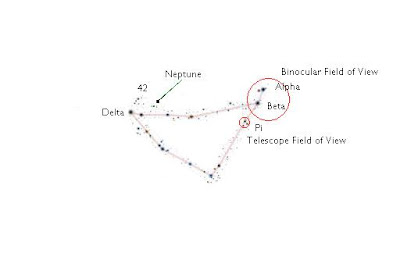
Even with good skies here south of Chicago, almost all of these stars are invisible to the naked eye. Alpha and Beta are just barely visible. The rest are binocular objects. The three little stars labeled 42 Capricorni are the limits of binocular magnitude around here.

The four smaller ‘field stars’ to the right of 42 Capricorni are just barely visible through my 2.4 inch (60mm) telescope.

With binoculars it’s a piece of cake to find Alpha and Beta Capricorni, then drop down to the three stars around Pi Capricorni, and then follow the ragged trail of dim stars east to Delta and Gamma (Gamma is the bright star just right of Delta, unlabeled here). With binoculars the three stars above Delta, 42 Capricorni, are visible, but the sky around them appears bare, no field stars at all.

Turning a telescope to Capricornus brings a whole new set of problems.

The field of view of a telescope is only about 1 degree, compared to 5 or 6 degrees for binoculars. My telescope uses a small ‘finder’ scope (20mm) to find and point at celestial targets. Looking at Capricornus, however, most of the stars are so dim in the light-polluted skies above me that my finder scope cannot see them.

As if the bad sky overhead wasn’t challenging enough, my neighbors all have ‘security’ lights on their garages at night. Some are VERY bright. That glare flares against the objective of my finder scope, washing out some stars that are bright. I had to make a lens shield from a rolled up index card to even use my finder scope with low, southern views.

I had to start at Alpha and Beta with the finder scope, just as I did with binoculars. Then, cupping my hand around my finder scope eyepiece and my eye to shield my own vision from the night lights, I starhopped south to the three stars around Pi.

They were just barely visible in my finder scope.

Then I moved east. And got completely lost.

With binoculars it’s an easy jump to Delta and Gamma. But with the finder scope I had to position Pi very carefully at the top of my field of view, then move east very carefully, moving slightly south at the same time.

That got me to Delta and Gamma.

My finder scope couldn’t see 42 Capricorni above Delta, but they are close enough that at 36x I could move upward with my telescope itself from Delta to the three stars of 42 Capricorni.

From this point, I could no longer use binoculars or my finder scope. Only my telescope could resolve the guide stars leading to Neptune.

Moving back west from the bottom of the three stars above Delta (that is, of the three stars above Delta, starting from the star nearest Delta), there are two very dim stars that form a line. The two dim stars are almost one field for me, and moving west two of those fields along the 'line' of the two stars takes me to two even dimmer stars which also make up one field for me. And between those two very dim stars, is one slightly brighter point with a visible greenish tint.

Neptune.

The cool thing about observing planets is you can always tell when you’ve got the right target because, night by night, a planet moves against the backdrop of stars. Neptune was close to the eastern-most dim star when I first observed it. Now Neptune is almost directly between the two.

Neptune will continue retrograde right past the second guide star, then stop, and then come back toward and then past the first star.

Motion like that used to cause early astronomers (and some Church figures) to invent all manner of weird celestial mechanisms to try to explain what they saw. Of course, they couldn’t see Neptune, but Mars, Jupiter and Saturn—what we now call the ‘outer’ planets—all exhibit retrograde, ‘backward’ motion against the stars. It’s caused by our view from here on Earth, also moving around the Sun.


Blue And Green: The Alchemical Sky

Sometimes little things have an effect on us that seems to be way out of proportion to our expectations. (Inca Roads Pt. 1 and Inca Roads Pt. 2) Starhopping through Capricornus has been like that for me.

(A ‘road’ is something we travel to get from one place to another. I used Capricornus to get from Aquila to Aquarius. Capricornus has been a kind of real Inca road for me...)

A couple weeks back, when I first went looking for Uranus, I observed Beta Capricorni for the first time. I was struck by the subdued beauty of the double star: Bright white primary, with a very dim, very blue companion. Very beautiful. I was so struck by the color and brightness contrast that I did a pencil sketch and then an oil pastel sketch of the system.

It didn’t occur to me until I was typing up the first few paragraphs of today’s post, but Neptune in Capricornus makes a kind of diptych with Beta Capricorni B.

Beta Capricorni B is invisible to the eye and, in a telescope, appears as a tiny point that is beautifully blue.

Neptune is invisible to the eye and, in a telescope, appears as a tiny point that is beautifully green.

Astronomers and chemists typically don’t have a lot of kind words for astrologers and alchemists. One way of looking at the differences between scientists and pseudo-scientists is that scientists look at the universe and ask, “What can our knowledge of the universe tell us about the universe itself?” Whereas an astrologer or alchemist looks at the universe and asks, “What can our knowledge of the universe tell us about ourselves?”

The beautiful, invisible points of blue and green at opposite ends of Capricornus have been trying to tell me something, but I don’t even know if what they’re trying to tell me is about me or the universe.

I’ll be giving it more thought.


Friday, September 14, 2007

Isaac Newton and Stephen Wolfram, Angie, Neptune


I certainly think it'll be an interesting--almost metaphysical--moment if we finally have a simple rule which we can tell is our universe. And we'll be able to know that our particular universe is number such-and-such in the enumeration of all possible universes.

It's a sort of Copernican moment: we'll get to know just how special or not our universe is.

Something I wonder is just how to think about whatever the answer turns out to be. It somehow reminds me of situations from earlier in the history of science. Newton figured out about motion of the planets, but couldn't imagine anything but a supernatural being first setting them in motion.

Darwin figured out about biological evolution, but couldn't imagine how the first living cell came to be.

We may have the rule for the universe, but it's something quite different to understand why it's that rule and not another.


Stephen Wolfram
“My Hobby: Hunting for Our Universe”


Pop writers sometimes wonder if Stephen Wolfram might be the Isaac Newton of our times. But I think it is more meaningful to compare Wolfram to Carl Gauss. Regardless of Newton’s tremendous accomplishments with math, I’ve never read anybody write anything nice about the guy as a person. And although Newton’s telescope design has become the standard among amateur astronomers, it’s pretty clear ‘empowering’ amateurs was about the farthest thing from Newton’s thinking in any context.

Carl Gauss, on the other hand, was both a mathematical genius and an all-around decent guy who always did his best to make a positive contribution to the world of science around him. He may have been the very first person to think seriously about non-Euclidean space. He was the teacher of Bernhard Riemann. And Gauss always kept practical matters in mind regardless of how esoteric his math studies may have been, working extensively with astronomy, cartography and other issues. And he was always willing to discuss math and science with anyone capable of participating, regardless of the social conventions of the era.

Stephen Wolfram is not only conducting fundamental research into the nature of the universe, but through Mathematica he is making sure his research tools and experience also benefit other workers, professional and amateur, involved with math intensive activities.

And even beyond Mathematica, Wolfram frequently takes time to post entries in his company’s blog, The Wolfram Blog, remaining engaged with the amateur science community at large.

That’s pretty cool stuff.


--------------------------------------------------------------------------------


Angie has stopped by the blog a couple times this week, but we haven’t managed to touch base in real life for quite a few days. And I’ve missed her because, if I remember right, she has her birthday around this time of year.

Happy birthday, Angie!


--------------------------------------------------------------------------------


A few days ago, Jim dropped me a note saying that he, too, has recently tracked down Uranus. Observing from near Seattle, Jim has also observed Neptune. Jim has documented his Uranus observing on his blog.

Jim’s note got me thinking about Neptune. I knew I couldn’t observe Neptune with my binoculars. Every time I starhopped through Capricornus I checked again to make sure that Neptune and the guide stars were too dim for my 50mm binoculars. They are. But my telescope is 10mm larger than my binoculars. I wondered if my 60mm telescope could pull in the fainter targets. And I wondered if I’d be able to starhop through Capricornus using the MUCH narrower field-of-view of the telescope.

The answers turned out to be yes. [!] I observed Neptune both Wednesday night and Thursday night! I’ll go into the details of starhopping to Neptune with a long focus telescope in my Monday post next week.


Thursday, September 13, 2007

Sir Isaac Newton: An Indian Perspective


Indian scholars predated Newton find by 250 yrs

15 Aug 2007, 0015 hrs IST,PTI


LONDON: A little-known school of scholars in south India discovered one of the founding principles of modern mathematics hundreds of years before Sir Isaac Newton, to whom the finding is currently attributed, according to new research here.

Dr George Gheverghese Joseph from The University of Manchester says the Kerala School identified the 'infinite series’ - one of the basic components of calculus - in about 1350.

The discovery is currently attributed in books to Sir Isaac Newton and Gottfried Leibnitz at the end of the 17th centuries, the University of Manchester reported in its website on Monday.

The team from the Universities of Manchester and Exeter reveal the Kerala School also discovered what amounted to the Pi series and used it to calculate Pi correct to 9, 10 and later 17 decimal places.

And there is strong circumstantial evidence that the Indians passed on their discoveries to mathematically knowledgeable Jesuit missionaries who visited India during the 15th century.

That knowledge, the researchers argue, may have eventually been passed on to Newton himself.

The research was carried out by Dr George Gheverghese Joseph, Honourary Reader, School of Education at The University of Manchester and Dennis Almeida, Teaching Fellow at the School of Education, The University of Exeter.

Joseph made the revelations while trawling through obscure Indian papers for a yet to be published third edition of his best selling book The Crest of the Peacock: the Non-European Roots of Mathematics, the report said.

"The beginnings of modern maths is usually seen as a European achievement but the discoveries in medieval India between the 14th and 16th centuries have been ignored or forgotten," Joseph said.

"The brilliance of Newton’s work at the end of the 17th century stands undiminished - especially when it came to the algorithms of calculus.


Copyright © 2007 Times Internet Limited


Wednesday, September 12, 2007

Nonstandard Analysis: A (Lost) French Perspective


The most famous mathematical mystic was no doubt Blaise Pascal. In answering those of his contemporaries who objected to reasoning with infinitely small quantities, Pascal was fond of saying that the heart intervenes to make the work clear. Pascal looked on the infinitely large and the infinitely small as mysteries, something that nature has proposed to man not for him to understand but for him to admire.

The full flower of infinitesimal reasoning came with the generations after Pascal: Newton, Leibniz, the Bernoulli brothers (Jakob and Johann) and Leonhard Euler. The fundamental theorems of the calculus were found by Newton and Leibniz in the 1660s and 1670s. The first textbook on the calculus was written in 1696 by the Marquis de L’Hospital, a pupil of Leibniz and Johann Bernoulli. Here it is stated at the outset as an axiom that two quantities differing by an infinitesimal can be considered to be equal. In other words, the quantities are at the same time considered to be equal to each other and not equal to each other! A second axiom states that a curve is “the totality of an infinity of straight segments, each infinitely small.” This is an open embracing of methods that Aristotle had outlawed 2,000 years earlier.

Indeed, wrote L’Hospital, “ordinary analysis deals only with finite quantities; this one penetrates as far as infinity itself. It compares the infinitely small differences of finite quantities; it discovered the relations between these differences, and in this way makes known the relationships between finite quantities that are, as it were, infinite compared with the infinitely small quantities. One may even say that this analysis extends beyond infinity, for it does not confine itself to the infinitely small differences but discovers the relationships between the differences of these differences.”

Newton and Leibniz did not share L’Hospital’s enthusiasm. Leibniz did not claim that infinitesimals really existed, only that one could reason without error as if they did exist. ... Newton tried to avoid the infinitesimal. In his Principia Mathematica, as in Archimedes’ On the Quadrature of the Parabola, results that were originally found by infinitesimal methods are presented in a purely finite Euclidean fashion.


Phil Davis and Reuben Hersh
“The Mathematical Experience,”
‘Nonstandard Analysis’


Abraham Robinson Wiki Page


Non-standard Analysis Wiki Page


Tuesday, September 11, 2007

Isaac Newton And Britney Spears


If Isaac Newton
had known Britney Spears, would he
have died a virgin?


Monday, September 10, 2007

Sir Isaac Newton: A French Perspective


Isaac Newton’s first great work appeared in 1687—on Halley’s dime—under the title Mathematical Principles of Natural Philosophy. Its success was almost immediate, thanks to faithful Halley’s aggressive propaganda. The book was not an easy read, however, and Newton, who held most mere mortals in utter contempt, claimed he had intentionally overcomplicated his demonstrations to make his theory accessible only to a handful of experts. He perhaps did so, as well, as a slight to Robert Hooke, who, though hardly partial to mathematics, had also claimed to have discovered gravity. Such a claim outraged the irascible Isaac, who had nearly avoided publishing anything at all; Newton made himself the bane of Hooke’s existence until the latter’s death in 1703. The genius could prove to be as petty as he was cruel: appointed warden of the Royal Mint, Newton sent to the galleys and gallows every counterfeiter he could get his hands on. Ennobled in 1703, then president of the Royal Society and later a member of Parliament, the former hermit polished up his image, surrounded himself with a court of admirers, offered portraits of himself to his guests and directed all his bile towards poor Gottfried Wilhelm Leibniz. The latter, a great mathematician of German origin, had made the mistake of publishing a method for calculating the infinitesimal without giving credit to Newton. This quarrel, too, only ended with Leibniz’s death in 1716. Sir Isaac Newton loved no one but his mother, the only person who had access to his rare displays of affection. He died a virgin in 1727.


“Mapping The Sky”
Leïla Haddad & Alain Cirou

(Originally published in France
by Éditions du Seuil / Association française d’Astronomie)


Friday, September 07, 2007

Magic, The Elder Gods, Fall Festivals


This weekend our suburb is having its big Fall festival. This is when we thank the Gods for our bountiful harvest. So far as I know, however, we don’t have a real Lottery or Wicker Man thing, so I don’t think the elder Gods are going to pay too much attention to our celebrating.

Which is okay by me. I’m not much of a festival guy. [One Fall a woman named Sandy and I were driving through central Illinois. Some small, rural town we got to was having their Fall festival. Parades, musicians, celebrations in the streets. We stopped for lunch and then walked around the town looking at the displays the farm-types had put together. On one street corner dozens of people were standing around watching and listening to a band, a kind of farmer skittle band, with drums made from steel tanks and home-made basses of some kind. Sandy looked at me and said, “Maybe I should go back to the car and get the camera…” I said, “Maybe I should go back to the car and get the gun.” A couple of senior citizens next to us heard me and they looked aghast, wide-eyed, mouths open. Sandy had to put her hand on the old guy’s arm and give him her best smile, saying, “We don’t really have a gun. That’s just his idea of a funny remark.” I’m not a festival kind of guy.]

This time of year my thoughts are on tennis. I’m a tennis guy. This is the two week span of the US Open tennis tournament. My favorite, however, Elena Dementieva, lost early, so I am not exactly a happy tennis guy.

One of my main thoughts during this year’s US Open has been how awful the television coverage has been. They show the same commercials, over and over. And they’re all terrible. Not only does that not make me want to buy the products advertised, but it makes me want to avoid those products, to specifically not buy them.

Although, touching on the topic of Fall magic and the elder Gods, I do admit that I will be looking for a new pair of shoes pretty soon and I will be looking at K-Swiss sneakers. Anna Kournikova does a commercial for them.


Thursday, September 06, 2007

Oil Pastels: The Cray-Pas History


If you read just about any book about oil pastels published for the art market, you get a ‘history’ of the medium built around Pablo Picasso and the famous French art firm of Henri Sennelier. There’s something weird and Orwellian about this, because the actual history of oil pastels started something like twenty years earlier in another country entirely! The corporate story of Sennelier oil pastels still tells only the French story.

Here’s the real story. From Japan.


When a child or adult picks up a Cray-Pas™ oil pastel and brings that smooth, bright color across paper, that person has no idea about all the elements that had to come together in the beginning to bring that color to the page.

Cray-Pas were born in the wake of The Taisho period of Japan (1910-1920), a time of great cultural upheaval. Despite the changes happening, the arts flourished.

In `20’s Japan, encouraging artistic creativity in children through free-form drawing was a revolutionary concept. Instead, copying models was the established method of teaching art to children.


In his book, The Theory of Jiyu-ga, translated as “Drawing without a Master,” Japanese artist Kanae Yamamoto put forth the notion that the focus of drawing should be on stimulating children’s creativity through color and drawing experimentation. It was from this idea that the seed of Cray-Pas sprung.

Along with his instructional theories, Yamamoto also recommended that the ideal medium for children to explore their creativity were materials that produced soft yet vivid colors.

At the same time, two private school owners in Tokyo, Rinzo Satake and Shoukou Sasaki started experimenting with the materials as a result of not being able to find suitable art products for children in their school. They named their new company Sakura Crayon Company.

As Satake and Sasaki began formulating their ideas, others in Japan were attempting crayon manufacturing at the same time with very uneven results.

In 1921, assisted and advised by the artist and theorist Yamamoto, the two brothers-in-law developed a high-quality crayon. Their product quality was heads above other Japanese competition, but still did not meet the high standards they were seeking.

The ideal art material the two of them were searching for combined the soft, smooth color application of crayons with the brightness of dry pastels.

This goal of application and color gave the still developing product its name, Cray-Pas with ”Cray” conveying the application ease of Crayon and “Pas” standing for dry Pastels’ depth and brightness of color.

After the Great Kanto Earthquake of 1924, Sakura Crayon Company moved from Tokyo to Osaka as the two men continued to try and perfect their product.

In one of its first product stages, Cray-Pas used a combination of coconut oil and a stiffening oil as the base, but both these ingredients were affected by extremes in temperature. As a result, Sakura originally produced a hard Cray-Pas for summer and a softer version for winter.

It took three years for Sakura Crayon Company to resolve this final development dilemma and develop the ideal combination of softness which made Cray-Pas sticks easy to draw and blend with. That formulation, developed in 1927, was the basis for the Cray-Pas kids and adults use today.

Fast forward to now: Cray-Pas are arguably the most well-known oil pastels. Sakura Crayon Company is now Sakura Color Products Company and is considered one of the most innovative art materials and writing instruments manufacturers in the world.

Cray-Pas oil pastels now come in three varieties and in many different sized assortments: Junior Artist for children, Expressionist for growing artists and students, and sharp-edged Specialist, designed for professional fine artists.

Sakura owns many fine works of art done in Cray-Pas and exhibits them at the Sakura Art Museum in Osaka, Japan.


Oil Pastel Wiki Page


Wednesday, September 05, 2007

Bee Dates Orchids Back To Time Of Dinosaurs


Bee dates orchids back to time of dinosaurs


Mark Henderson, © Copyright 2007 Times Newspapers Ltd.


The earliest evidence of orchids shows that the plants may have coexisted with the dinosaurs.

Scientists have been able to calculate the age of the orchid family with greater accuracy than was previously possible after the fossilised remains of an extinct bee with a mass of orchid pollen on its back were discovered in the Dominican Republic in 2000.

An analysis of DNA extracted from the pollen, led by Santiago Ramirez of Harvard University, suggests that although the fossil itself is 15 million to 20 million years old, the genetic roots of orchids stretch back much further.

Dr Ramirez estimates that orchids appeared between 76 million and 84 million years ago, at a time when dinosaurs such as Tyrannosaurus rex were still living. Previous estimates have variously put the origin of orchids as recently as 26 million years ago and as distant as 112 million years ago.

“Since the time of Darwin, evolutionary biologists have been fascinated with orchids’ spectacular adaptations for insect pollination,” Dr Ramirez said. “But while orchids are the largest and most diverse plant family on Earth, they have been absent from the fossil record.

“Our analysis places orchids far toward the older end of the range that had been postulated, suggesting the family was fairly young at the time of the extinction of the dinosaurs some 65 million years ago.

“It appears . . . that they began to flourish shortly after the mass extinction at the so-called K/T boundary between the Cretaceous and Tertiary periods, which decimated many of Earth’s species.”

While many ancient plants have become fossilised, orchids are largely absent from the fossil record because of several factors. The flowers bloom infrequently and are concentrated in tropical areas, where heat and humidity prevent fossilisation, and pollen, which is easily destroyed, is carried only by insects and animals and never by wind. Details of the discovery are published in the journal Nature.


Tuesday, September 04, 2007

Star Hopping


I did some cool star hopping over the weekend. (No, sadly, I don’t mean I went dancing with Lindsay Lohan and Tara Reid.)

Star hopping is a method of finding your way around the sky. You start at some star or constellation or asterism you recognize and shift your field of view just a bit in one direction or another, to another star or constellation or asterism and then use that as a jumping off location for another shift. This is a typical way to find constellations you’ve never observed, or locate celestial objects that can’t be seen with the naked eye.

I was after this. Uranus. Uranus is in Aquarius. This month, Uranus is reasonably bright, at magnitude 5.9. That’s too dim to be seen with the naked eye from around Chicago, but Uranus should be visible in binoculars.

I’ve seen Mercury, Venus, Mars, Jupiter and Saturn. But Uranus, Neptune and Pluto are difficult targets.

I had three types of charts. I had the simple, full-sky charts published every month in Sky & Telescope and Astronomy magazines. I had detailed constellation charts and photographs in a great book, “Observing The Constellations,” by John Sanford. And I had a detailed ‘finder chart’ for Uranus published in the July, 2007, Sky & Telescope magazine.

I had a pair of 10x50 wide angle binoculars and my 2.4 inch refractor telescope.

It was a good news/bad news start: Uranus was relatively bright, as the outer planets go. And Uranus was very close to a ‘regular’ star that could be used to find its position, Phi Aquarii. However, Aquarius is one of those ‘low-in-the-south’ constellations that I had never observed. Also, Aquarius is a rather large constellation with no particularly bright stars or eye-catching asterisms.

It was a challenge, but I very much wanted to add the planet to my ‘life list’ of cool astronomical things I’ve seen.

My plan was very simple. I intended to start with Altair in Aquila. Altair is one of the brightest stars in the sky, part of the well-known ‘Summer Triangle’ with Vega and Deneb. From Altair I’d star hop slightly to the north to Delphinus, then shift east to Equuleus, and then straight east to the horizon to find the two brightest stars in Aquarius.

Altair is easy, and Aquila is a beautiful constellation. I found Delphinus easily. Gamma Delphini turned out to be a nice double star. I shifted to Equuleus with no trouble.

But the large star hop almost down to the horizon looking for Alpha and Beta Aquarii got me totally lost. I couldn’t make heads or tails out of the unfamiliar, very sparse star fields.

After about an hour of making trips from my backyard into my house to consult the full-sky charts, trying to single out little two-star sequences east of Equuleus, I decided to call that idea a failure and abandon it. I hated to do it, but when you’re lost it’s an obvious feeling in your gut. You’ve got to re-group.

So I studied the full-sky charts. I couldn’t make the star hops work approaching Aquarius from the zenith, so I decided to again start from Altair in Aquila, but instead of moving north to Delphinus I’d move straight south to Capricornus and then, from Capricornus, move east into Aquarius.

This was a tricky plan because Capricornus is also a low constellation I’d never before observed. But the two brightest stars of Capricornus seemed to be directly ‘under’ Aquila and they formed a reasonably distinct visual line.

And they did. Alpha and Beta Capricorni turned out to be visually striking in binoculars. Alpha Capricorni is a complicated multiple star system that’s very easy to see. Beta Capricorni is also a multiple star system, a telescopic double that’s very beautiful. The two components are very different. One is bright and white, the other is very dim and richly blue. It instantly became one of my favorite double stars.

From Alpha and Beta Capricorni, I star hopped east and, bingo, right to Mu and Epsilon Aquarii. From the vertical pair in Capricorn to a horizontal pair in Aquarius.

I had gotten to my target constellation. Now I had to work across the large constellation and then, darn it, farther down and closer to the horizon.

Mu and Epsilon Aquarii ‘point’ directly east, toward Beta Aquarii. Beta was reasonably bright and had Xi Aquarii just below it. Star hopping farther along the same line—Mu and Epsilon to Beta, then Beta to Alpha—was easy. Alpha Aquarii is a little three star sequence. Easy. Then there’s a short hop to the east to another three star sequence of Eta, Zeta and Gamma. Easy.

Then came a tricky part. Changing direction and moving down to the horizon.

Starting at the ‘left-most’ of the three stars, Eta Aquarii, I star hopped down to Lambda Aquarii. Seemed easy, the only reasonably bright star there. Then, the slightest shift east again got me to my destination [!], Phi Aquarii. For great confirmation of where I was, Phi is just above a tight, dim little three star grouping of Psi Aquarii 1, 2 and 3.

There was Phi Aquarii.

And there, EXACTLY as the detailed finder chart depicted it, was Uranus. A TINY little speck, but clear. I estimated it as half a degree away from Phi. I later checked. It was .3 degree away.

Through my telescope I couldn’t make out any disk. The highest power I use is 100x, and Uranus only resolves to a disk in at least 150x. But I could catch a hint of the aqua color. It may have been my imagination, but compared to the white of Phi Aquarii I believe I did see a green-blue tint to Uranus. Very cool.

One odd thing about star hopping is that even if the sequence is convoluted and difficult when you first do it, it becomes almost trivial to do it again.

I first observed Uranus Saturday evening and, later that night during commercials on the coverage of the US Open tennis tournament, I would grab my binoculars and go out to the backyard. The hops were fast and almost casual. Aquila to Capricorn to Aquarius, then across the constellation and down to Phi and Uranus.

Very cool.

Now I’ve seen it.

And there is a very big fringe benefit to finding Aquarius by going through Capricornus.

Neptune is in Capricornus. Neptune is next on my list.

However, while Uranus is magnitude 5.9, Neptune is MUCH dimmer, at magnitude 7.9. With Chicago skies and my optics, limiting magnitude is about 6.5, even on a good night. (When I was passing through Capricornus I checked out the area between Gamma Capricorni and Iota Capricorni. Neptune was there, between them and a degree or two north, but it was completely invisible to me. Even the field stars north of Gamma and Iota were invisible to me.)

But the outer giants move very slowly. Someday I’ll revisit Capricornus armed with something like a four inch refractor or an eight inch reflector. Or I’ll have my trusty binoculars and small refractor under really good skies where magnitude 7.9 will be just accessible. Then I’ll get Neptune.

Pluto will have to wait for me to get a piggy-back camera on a motorized drive.

Those things will be future posts.

But I’ve seen Uranus. That was my labor for the Labor Day weekend.