Monday, January 31, 2011

Things Libraries Throw Away


Several years ago, while at Washington University in St Louis, I headed to the Biology department library to return some books. As many libraries are wont to do, they were chucking out old copies of books, and looking through the pile I managed to score a few classic texts, including Lynn Margulis' "Early Life". Astoundingly, tucked inside, was a photocopy of a letter sent to Lynn on 2 June 1982 (the letter is typewritten, and the photocopy seems to have been made not long after and has a handwritten note by Lynn in the top corner). ...

Treasures In Old Books
Stages Of Succession


She later formulated a theory to explain how symbiotic relationships between organisms of often different phyla or kingdoms are the driving force of evolution. Genetic variation is proposed to occur mainly as a result of transfer of nuclear information between bacterial cells or viruses and eukaryotic cells. While her organelle genesis ideas are widely accepted, symbiotic relationships as a current method of introducing genetic variation is something of a fringe idea. ...

from Lynn Margulis at Wikipedia


It must be exciting to be a published writer,
to sit with other writers in a sidewalk cafe,
drinking, talking, watching the world go about its day,
sighing, shrugging, saying, “Yes, you must be a fighter”

when yet another library makes its shelves lighter
by checking a print-out and throwing your books away.
Rubbing scalp that used to be gray hair, someone will say,
“That pretty Vanity Fair ass ed—”     “Juli?”     “Right, her—

has a best-seller now, published by Vanity Fair,
about working at Vanity Fair, how the wacky,
smart, pretty, fun people there make life never a bore.”

It must be exciting to nod and be part and share.
“I read it on Kindle,” you say, matter-of-factly,
“Juli’s best-seller, On Being A (OMG!) Whore.”


Friday, January 28, 2011

Moonlight Becomes You


If I say I love you
I want you to know
It’s not just because there’s moonlight although
Moonlight becomes you so


“Moonlight Becomes You”

Moonlight Becomes You is a popular song,
composed by Jimmy Van Heusen with lyrics
by Johnny Burke. The song was written for
the Paramount Pictures release Road to Morocco (1942)
and published in 1942 in connection with the film.
Vic Schoen (staff arranger for Paramount)
wrote the arrangement.


There was moonlight. And then Hollywood light.
And I guess there was Hollywood moonlight,
which was electric and didn’t look much
like real moonlight but everybody knew
it was pretend and pretending was fun.

I’ve studied the Moon through a telescope
and I’ve seen my share of Hollywood light.
I think real moonlight can become someone.
And I think Hollywood light can be fun,
although Hollywood moonlight is pretend.

I think almost everybody today
is television light. It’s not moonlight.
It’s not pretend. And in it there’s no fun.
If I say “I love you” you might glow but
television moonlight is just a show.


Thursday, January 27, 2011

Quasi Una Flying Car Fantasia


Moonlight and love songs
Are never out of date


When birds are gone and cars are flocking overhead
I’m sure fancy software will keep everybody
on course, safe and no one will hit anybody.
Will flying cars have horns for when we’re seeing red,

when we’ve gotten up on the wrong side of the bed
and we’re flocking along right next to somebody
too close in a junker with a dented body
and their suburban flying messes with our head?

When cars are the new birds and cars need to make noise
it would be a nice tribute to our feathered friends
if cars had little keyboards or high-tech guitars

and we had to make music and sing with our toys
to warn off bad flyers and avoid bumping ends.
Songs should be the price we pay for our flying cars.


. . . . . . . . . . . . . . . . . . . . . . . . . . . . . . . . . . . . . . . . . .


Hot Red Earth, Cold Blue Jazz


Cars Are The New Birds


No Bird Shadows On The Analemma


Romance, Cinema And Science Fiction Dreams


Wednesday, January 26, 2011

Like Before The Internet Went Psycho


It’s easy for old people like me to talk about how Twitter and Facebook have turned the internet into the cyber equivalent of Wal-Mart—an ugly, over-crowded mess full of hapless, hopeless shoppers who have nothing to say yet still talk too much.

(Some of us who lived through the CIS/AOL wars have never gotten over the AOL victory.)

So now what used to be an interesting community of smart, fun people to talk to is just wall-to-wall scoundrels calling people names and saying, endlessly, “I liked that!” or “I didn’t like that!”


But a few days ago I saw the internet working like it used to work, a cool place, smart and fun and interesting.


It started here, in a little town in Greenland named “Ilulissat” where people have lived for something like 4,000 years. That’s even longer than the internet has been around, for you AOL readers. (Sorry. I’ll stop.)


Every year on January 13th, people from all over Greenland trek to Ilulissat because the Arctic night ends and the Sun rises for the first time, ending their long winter darkness.

It normally looks something like this:


But the people of Ilulissat were shocked this year when the Sun appeared something like two days early.

And thanks to things like Twitter and the rest, a lot of people freaked out about it.

In Britain, the Daily Mail did an article about it, speculating that maybe global warming was causing glaciers to melt:

The sun rises two days early in Greenland, sparking fears that climate change is accelerating


And AccuWeather wondered if extreme methane buildup might be changing atmospheric refraction (this was at least a reasonable kind of wild theory which, in fact, might still be true):

"Sunrise" Two Days Early in Greenland


Other internet sites were less reasonable. Much less.

At ZetaTalk they blamed the impending crustal shift and end of the world, and at Sorcha Faal they also were talking about the end of the world:

Of course this is from the Earth wobble, which has gotten increasingly violent and extreme

Greenland Sunrise Shocks World As Superstorms Pound Planet


Gads.

There are a lot of astronomers and astrophysicists in the world and many of them have websites. Astronomers, in particular, are some of the friendliest people in the world. If someone thinks the world’s ending, they should—excuse me—fucking look around for an astronomer’s website and ask him or her if, in fact, the world is really ending. They’ll give a good answer!

I stopped in at an astronomer’s site called, The Half-Astrophysicist Blog, by Rob Sparks. Not only was he looking carefully at the phenomenon without going crazy, but—just like the good old days before AOL!—smart and interesting people were dropping in to chat and share some cool facts.

In fact, a high school physics teacher who lives in Greenland [!] stopped by and gave some local background and then contacted the Niels Bohr Institute at the Copenhagen University and got the real expert opinion of what had happened. As most reasonable people had kind of figured out, the “early sunrise” almost certainly was an atmospheric effect similar to a common mirage. And as more reports filtered out, it wasn’t really too unusual of an occurrence after all.


People who looked around for an astronomer got the facts and got help cutting through the crazy and got some fun, interesting background info just for hanging around. That’s what the internet can do when the Facebook and Twitter nuts and scum are ignored.


If only it could always be that way.


(And yes I realize that by calling the Facebook/Twitter people names I’m just being a contemporary scoundrel, but I don’t do it often and it really is awful what they’ve done to the online world. I don’t like that! )


Tuesday, January 25, 2011

The Sound Of One Hand Chording


Why should I care
If I have to cut my hair
I’ve got to move with the fashions
Or be outcast


Today’s post is kind of trivial, but it’s interesting to me. And I’m going to be talking about this more in the future so I wanted to get this topic started.


I’ve always been interested in similarities and differences between music produced by guitars and keyboards. Now that everything can be synthesized there are still differences. I suspect the differences in part grow out of the way keyboards and fretboards each favor different kinds of chord voicings.


These are four voicings of a G Major 7th chord.

The two GM7 chords on the left are typical one-hand voicings for keyboard. The two GM7 chords on the right are typical four-string voicings for guitar. These have the root in the bass, then in the treble.

The keyboard voicings are closed, with all the notes being drawn from within an octave. The guitar voicings are a little more open with one note outside the octave of the root and that’s just because of the way guitar strings are arranged.


I suspect the typically slightly more open voicings of a guitar are why folk singers—to many listeners—sound better plucking away at simple progressions on guitars than they sound plunking away at simple progressions on a keyboard.


When I watch jazz keyboard players perform, they usually look very relaxed, with their left hand chording low bass voicings and their right hand playing a couple of octaves up for melody lines or comping chords.

And this sounds wonderful. I’m thinking of music like Vince Guaraldi’s.


But I’ve heard and seen guitar players—folk musicians and rock musicians—perform on keyboards and, often, they seem to play all cramped up with their hands close together and they sound as bad as they look.

I believe—I might be wrong, I don’t have a lot of keyboard experience—I believe these guitarists are sitting at the keyboard and kind of locking their hands together and using two or three fingers of each hand, together, to mimic familiar guitar voicings on the keyboard.


This does not seem to be a good idea.


It doesn’t look good. It doesn’t sound good.


I mean, what the hell, if you’re going to be using both hands at once, why not move them apart and play the keyboard properly?


(I know that I am also raising another issue here—why should the exact same chord voicings played with two hands on a keyboard sound or be experienced differently than when they are performed with one hand on a guitar? I’m ignoring this issue today because I think it needs a post of its own and I’ll do this some other time. It’s also, I strongly suspect, much harder to answer.)


I’ve already put up Pete Townshend’s incredible guitar performance of “Pinball Wizard”—on acoustic guitar!—and said it is my favorite guitar performance of all time. It is.

I like Pete Townshend a lot. (And I haven’t even begun to talk about his song “Rough Boys.” That's a whole other topic for another day.)

But here is Pete playing “Cut My Hair” on piano.

I don’t think this is good. I don’t want to be a h8er [laughs] but he should not do this. Nobody should do this. (And at this show, which looks like kind of a solo show, he has a helper keyboard player way off to the side. Harumph.)

I’ll be posting more about guitars and keyboards, but I wanted to get the topic started and I wanted to have these two Pete Townshend performances up as points of comparison. (Soon I hope to have examples of my own, but, you know, on keyboard I don’t want to look or sound like Pete so I still need a little work.)


. . . . . . . . . . . . . . . . . . . . . . . . . . . . . . . . . . . . . . . . . .


Affektenlehre


Monday, January 24, 2011

Feral Kangaroos And Women


“Caroline Wozniacki's desperate attempt to reinvent herself took a bizarre twist yesterday with the world No. 1 being forced to recall the media to a second press conference to declare that she had not been mauled by a feral kangaroo. ...”

Open slather: Kangaroo cleared of wrong-doing
The Sidney Morning Herald, January 24, 2011


At U.S. Submarines we have developed the world's first personal luxury submarines, capable of taking you and your guests to unseen regions of the deep ocean in perfect comfort and absolute safety. And once there, you are able to view the fascinating denizens of the deep through large, panoramic viewports, while relaxing in an interior replete with luxury and warmth.

Powered on the surface by twin turbocharged marine diesels, all of our luxury submarine models, with the exception of the small Triton 650, have extended surface range and are capable of diving to 305 meters (1000'). Bad weather? Simply close the hatch and dive, cruising effortlessly far below the waves in air conditioned comfort. The submarines' battery capacity and life support systems allow you to stay submerged for days at a time.


I used to think it would be a romantic trip
to fall in love, buy a small boat, sail off to sea—
blue water, blue sky and a woman holding me.
I’d pour German wine in paper cups and we’d sip.

Then the odd color oil bubbled out of the rip
in the Gulf of Mexico and my fantasy
woman, too, became odd fiction like a crazy
woman tennis player and her kangaroo quip.

Now that women are as wrecked as ocean water
I’m thinking a boat, even a big boat, won’t do.
I’m thinking a submarine can sink through the gunk—

a craft that can falter as my spirits falter.
As feral women explain to the press what’s true,
I want to sink. Just like they say Atlantis sunk.


Friday, January 21, 2011

Something Heroic And Remote


“I’ve always wished I was a professional dancer,” Linda said.

I said, “Don’t dancers have to be really skinny?”

Linda made a face—women who know me have to be able to make lots of faces—and said, “Shut up, you asshole.”


I hadn’t thought about Kate and Anna McGarrigle for a long time. But I saw today that Kate McGarrigle passed away last year.


One time Linda and I had a big fight and I took back a lot of my stuff from her apartment. As I was getting ready to leave, Linda picked up my copy of Kate and Anna McGarrigles’s album, “Dancer With Bruised Knees.”

Linda kind of embraced the album and made a face at me that I hadn’t seen before. I thought of that observation from Degas, “The dance instills in you something that sets you apart, something heroic and remote.” Linda said, “I’m keeping this album. I love this album. You can take the rest of your stuff. It’s your stuff. But I’m keeping this album even though it’s yours. I’m keeping this album.”

I loved dancing with Linda. She used to hold me just like she held that album.


I’m sad, learning that Kate McGarrigle passed away. She was great. I hold my memories of hearing her and her sister sing as closely as Linda held her album.


. . . . . . . . . . . . . . . . . . . . . . . . . . . . . . . . . . . . . . . . . .


Kate and Anna McGarrigle at Wikipedia


Something That Sets You Apart


Christmas Witches: Ogres And Showgirls


Thursday, January 20, 2011

The End Of The World Shaken Not Stirred


A pilothouse sailboat, a midsize boat,
is large enough for its own laundry room.

Companies make washer-dryer units
that fit inside a little cabinet.

This has become a goal I’m working toward.
When the continents sink under the waves—

the black, oil-stained waves hot from lava flows—
I want to be sailing into the gloom

reading peacefully by electric light
and I want to wear a clean, dry tee shirt

that smells like Gain Joyful Expressions soap.
I know we can’t fight the Apocalypse

but with careful financial management
and high technology we can fight dirt.


Wednesday, January 19, 2011

Pretty Flowers, Taylor Swift, Killer Whales


Some of the stores around here have started selling flower seeds.

It’s kind of early, but I may pick up some zinnia seeds. I don’t have a garden area right now so even if Spring arrived early—I mean, really early—I wouldn’t have a place to plant the seeds. But Spring is a while away and I’m hoping that by the time the warm weather comes I will have a place to plant some flowers.

Zinnias are my favorite colorful flower. Marigolds bloom longer, but zinnias have beautiful colors.

Today’s post is kind of convoluted in a pointless way, but I’m going to put it up anyway just because it makes me smile.

It goes like this:

I was walking through a nearby store and saw them selling flower seeds. That made me think of the little garden space I used to have. That made me think of the posts I’ve done about gardening and—for some reason—I’ve come to associate Taylor Swift with my old garden just because, I think, I randomly juxtaposed Taylor Swift and gardening once.

Doesn’t she look happy about it.

Now I’m stuck thinking about her when I think about gardening.

Even though I’ve never actually heard a Taylor Swift song. I kind of hate fake country music to begin with so I was not inclined to listen to her. And one time I did try to listen to her sing—when she did a duet with Stevie Nicks—but Taylor Swift’s voice sounded so, ummm, odd that I couldn’t listen.

But I got to thinking about her because of the flower seeds on sale at the store.

Then, this afternoon when I was looking around the net I stopped in at a scuba diving and shark diving website I look in on now and then and they had a link to a video that was a parody of some Taylor Swift song.

Taylor Swift synchronicity.

Now, I’ve never heard the Swifty song the parody is based on, but the parody is pretty funny. So even though I think I’ve been linking too often to videos, I’m going to link to this one because it’s part of this Taylor Swift diptych.

Diptych used like that sounds like a bad word. Sounds like a Russian curse word. But it’s not.

So, here’s the Taylor Swift parody and I’ll try to have something more substantial for tomorrow. And I’m going to try to stay away from video links for a while, too.


. . . . . . . . . . . . . . . . . . . . . . . . . . . . . . . . . . . . . . . .


I’m Picturing Taylor Swift Naked


Atlas Shrugged, Taylor Swift, Shangri-La


Taylor Swift With No Makeup


Tuesday, January 18, 2011

Romance, Cinema And Science Fiction Dreams


“If such things exist,
if they are possible,
then everything is.
Magic. And God.”


What can it be?
What is the reason?
Is this the end
To all that breathes, and
Is it just something in your head?
Will you believe it when you’re dead?
Green slime!
Green slime!
Green slime!


Watching “A Clockwork Orange” at a midnight show
at Northwestern University, surrounded
by smart young men and young women, many dressed up
as ‘Alex,’ most of us speaking his lines with him.

Watching “The Green Slime” in a packed hotel ballroom
at two-thirty in the morning, with everyone
in the science fiction convention’s movie room
singing along to the lyrics in the theme song.

Of course I know I can’t ever meet ‘Gwen Conliffe.’
And I know I don’t want to meet Emily Blunt.
Is it a science fiction dream to hope to meet
a woman more Emily’s ‘Gwen’ than Emily?


. . . . . . . . . . . . . . . . . . . . . . . . . . . . . . . . . . . . . . . . . .


The Pressures Of Being A Real Life Princess


Monday, January 17, 2011

Thinking About Perspective


Okay, first of all, the 2011 tennis season has started in Australia.

There’s so much weird stuff going on in the world now—Goblin Universe type stuff—that it’s hard to think about tennis. But it’s important to maintain perspective. Or at least try to maintain perspective.

Australian Open 2011 Home


Also, right as I’ve posted some other things about plasma dynamics possibly playing a more central role to astrophysics than is commonly thought a story breaks about thunderstorms riding along magnetic lines of force and generating positrons and gamma ray bursts. Pretty cool stuff.

Thunderstorms That Shoot Antimatter


There was also another story about storms and electricity coming out of the Middle East that was summarized at an electric universe site:

Rainmaker: Arid regions are influencing their weather using electrical technology


And I’m not going to go off about dying animals again this week, but now cows have died in Wisconsin:

Wisconsin farmer shocked to discover 200 dead cows; officials think cattle had deadly virus


I’m guessing everybody has noticed at least some of the odd points about this story: 200 dead cows in Wisconsin: odd conflicting information given about dead cows?


This week I kind of wanted to talk about crayons and pencil drawings and maybe a little about guitars and keyboards. (The January issue of Keyboard magazine has an ad for the new Roland Juno Gi keyboard featuring a guitar player using the device as an amp. And the same keyboard magazine has a piece on Melody Gardot with a photo of her sitting next to her guitar. wtf?)


So I kind of wanted to talk about some trivial stuff this week. But with so much interesting and seemingly serious stuff going on, I’m not sure I want to talk about crayons. I’m going to think about this some more.


I’m not sure what I’m going to do this week. So I’m starting just by tossing all this stuff out here.


Friday, January 14, 2011

Basically Just The Lovemongers Doing Zeppelin


On Fridays I like to have something special, but today I’ve got nothing.

Yesterday I sort of summed up the bird and car stuff I’ve been talking about. I’ve got one more post about birds and cars, but I want to include a song and I want to play it on keyboard, but I’ve got a little work left to do before I can actually do that. Well, I can do it now, but not so that I’d want anybody to see and hear me. Soon. I’m getting better.

I really am kind of worried about the birds around here. They haven’t completely disappeared, but except for one set of bushes, the plants are empty. And the largest “bird bush” around here—which is usually so full of birds you can hear them chirping half a block away—only had three birds in it today. I know because I stopped by and tugged at a branch and the sparrows popped out at the top to see what was going on. Three birds.


Then I was going to do a post about fluid turbulence. I know it sounds obscure, but there are many interesting and odd things going on with the clouds of Jupiter and Saturn and there is a particular kind of turbulence—called “Kelvin–Helmholtz instability”—that is worth knowing about. And it is an issue in the electric universe world of plasma, too. But I never actually got around to writing anything. Oops. I’ll get back to that. But here’s a cool graphic I was going to use. And here’s a link to a cool site all about fluid turbulence.


So that’s about all I’ve got even though it’s a Friday. I should have planned better and worked harder. Sorry. I’m ashamed.

Anyway, here’s a weekend video. It’s the Lovemongers [!] playing an old Zeppelin [!] song:


Thursday, January 13, 2011

No Bird Shadows On The Analemma


A Massachusetts company hopes to start delivering its flying car to customers by late 2011. Terrafugia Inc., founded about five years ago by MIT graduates, got a key go-ahead last month when the Federal Aviation Administration granted a special weight limit exemption to the company for its flying car -- or "roadable aircraft" -- which is called the Transition. With that FAA clearance under the its belt, the company said it is on track to deliver the first Transitions to customers late next year. The Transition, which is designed with foldable wings, successfully completed its first flight on March 5, 2009, after six months of road testing. "To actually have it fly is a dream come true," said Richard Gersh, a vice president at Terrafugia.


Sometimes the records sell the movie. There’s less room for score when there are songs so certainly there’s an impact there on me as a background film composer. I just think it’s hard for filmmakers to stand up to an industry that has a sales dynamic so prevalent in the decision making about product right now. It’s as if in the car industry people who sold the cars were telling the engineers how to make a car. Like, that engine should have twenty cylinders because people like cylinders. You know, it kind of doesn’t make sense to me but I think it’s the reality of how business is done now in the industry.


Composer Shirley Walker
(on her commentary track)


Normally in cold weather around here
sparrows hang out in bushes, packed so thick,
their chirps so loud, their jumps and shoves so quick,
bushes seem to shiver but sing with cheer.

The weather this week has been cold and clear
but it’s as if the cold bushes are sick—
without a bird a branch is just a stick.
Wind whistles. Sticks shiver as if in fear.

I saw six or seven birds a week back
and took a picture. Now the birds are gone.
Businessmen will sell a flying car soon.

I imagine some advertising hack
will declare the science fiction dream won.
We’re George Jetson! The Earth becomes the Moon.


. . . . . . . . . . . . . . . . . . . . . . . . . . . . . . . . . . . . . . . . . .


Cars Are The New Birds


“Pretty Horrifying But Actually Very Real”


Hot Red Earth, Cold Blue Jazz


        “Help! Jane! Stop this crazy thing!”


Wednesday, January 12, 2011

“The Honeymoon Machine”


Today’s post is just a personal note. I’ve made a change to my profile page, adding a movie to my favorite movie list. I’m not sure how I left off this movie years ago when I made that list. And I did an earlier post about this movie and still didn't add it to my favorite movie list.

Roulette And The Magic Of Math


“The Honeymoon Machine” was released in 1961, the year after I was born. But it used to be on television a lot. As a very young kid I saw this movie on TV and it was the first movie that I ever made a mental note to remember, to check the TV guide and keep a look out for. I think I’ve seen this movie more times than any other film.


Jim Hutton plays a brilliant computer scientist and Steve McQueen is an audacious young naval officer. Hutton is on McQueen’s boat to test his new computer that can track missiles and predict their reentry trajectory. McQueen realizes that, in theory, that process is very similar to predicting a roulette ball falling onto a roulette wheel. Hutton says predicting roulette is impossible. But he’s a brilliant computer scientist and his computer is the fastest computer ever built and McQueen talks him into attempting the impossible: using the computer to beat the odds at roulette in a casino.


So there are a lot of really funny misadventures along the way and they both meet interesting women and get involved with romance along the way. And they kind of succeed, after a fashion, although, of course, nothing works out the way a person plans.


This is a wonderful Hollywood screwball comedy, but the remarkable thing about the film is that right about the time the movie came out, some very famous people were actually trying to do almost exactly what the film narrates.

Edward Thorp and Claude Shannon—Claude Shannon for heaven’s sake!—created a special purpose little computer, the first known such device in history—and attempted to use the computer and some fancy physics and math to beat a casino’s roulette odds.

“The Invention of the First Wearable Computer”


And, as if that wasn’t bizarre enough, a few years later a wild group of young physicists attempted to do it again, with better technology. And they did it!

“The Eudaemonic Pie”


This kind of thing is still going on today. It’s not talked about openly, even on the internet. (Yeah, there are some topics that aren’t talked about on the internet!) But using high tech resources to try to scam casinos is a bizarre and thriving kind of subculture.

“The Honeymoon Machine” was a screwball comedy but in real life trying to scam casinos doesn’t generate a lot of laughs. From what I’ve heard, and I may be wrong, but from what I’ve heard when people try to do stuff like this and get caught they get locked up, or decide to leave the country or just kind of disappear.


But it’s a great movie. And it would be cool to do it for real. Or something like it.


Tuesday, January 11, 2011

An American Tune In Oostburg


We come on a ship they call the Mayflower
We come on a ship that sailed the Moon
We come in the age’s most uncertain hour
And we sing an American tune


I don’t like to talk about politics on this blog, not directly at least. I’ve talked about conspiracies once or twice and that seems fair. But I’m not going to talk directly about politics.

But there is something operatic about the conception of America and I’m just going to touch on that today.

Regardless of what happens here, in North America, over the next few years, I think “America” as something of a global concept has been planted and taken root on a global scale and, for better and for worse, that Novus ordo seclorum is here to stay and even to flower.

Even if we, here, drop the ball—or have it knocked out of our hands—we’re not playing this game alone.


Today’s post is about a music teacher and his student in Oostburg—that’s over in Europe, in the Netherlands—performing a song called, “An American Tune,” by Paul Simon.


I’ve never been to New York. I’ve never seen the Statue of Liberty in real life. When I think of the Statue of Liberty, I think of three things.

The famous scene from “The Planet of the Apes” when the astronaut learns the truth:


And I think of the painting by Peter Max:


And I think of the song “An American Tune,” by Paul Simon. Here is a performance of that song by a music teacher on an upright piano and his student playing a cello:


. . . . . . . . . . . . . . . . . . . . . . . . . . . . . . . . . . . . . . . . . .


This Scary, Pumpkin Time Of Year, Part Two


“Yet Baghdad Is”


The Harajuku Station Forever


Monday, January 10, 2011

Cars Are The New Birds


A telephoto lens and excessive cropping
can make small things far away appear to be near
and the flat space makes gaps between things disappear.
Cars parked in a lot are far from sparrows hopping

on bushes in the sun, farther from me stopping
to photograph reality that looks so clear,
that doesn’t look like a metaphor space to fear.
But when gaps disappear and space flattens, chopping

reality into planes where nothing is plain,
the sunlight is still light and shadows are still dark.
If all the birds vanished, parking lots would remain.

Things happen far away then again in our brain.
Are birds singing, or did a car pull up and park?
Photographers, lost between things, try to explain.


Friday, January 07, 2011

Famishius Vulgaris Ingeniusi


A few days ago I talked about supervillains and I mentioned that my two favorite supervillains were from Smallville, Lex Luthor and Lana Lang-as-the-witch.

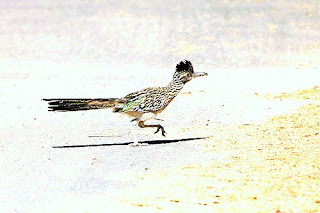
Somehow I forgot this guy, my all-time favorite supervillain:


I am not a billionaire or a witch
and I am not a postmodern ogre
out of European antiquity.

I am a hungry coyote alone
in a desert where the colors are bright.
I’m wily and I’m a super genius
and I’m chasing a bird that’s only fast.

I’m hairy but I can walk like a man
and I’m going to catch that bird. I am.
I’ve thought out everything. I have a plan!


. . . . . . . . . . . . . . . . . . . . . . . . . . . . . . . . . . . . . . . . . .


Love Sonnet With Piano Wreckage And Worms


Christmas Witches: Ogres And Showgirls


Thursday, January 06, 2011

Hot Red Earth, Cold Blue Jazz


What do you think about a possible link between all the bird deaths in Beebe and the drum die-off in Oxford?


My perspective is that I personally cannot imagine how there is a connection between these two events. With the drum feeding primarily on mollusks in the bottom of the river, if there was something that was affecting them – and this is a pretty deep river – maybe 30 feet deep. So, we don’t know diseases that go from fish to birds or the other way or environmental circumstances that would affect a bird and a fish 120 miles apart. So, it’s just not likely that they are connected. We’re hoping to get results fairly soon on the bacteria and virus cultures and that’s going to be very telling.


Mark Oliver
Chief of Fisheries,
Arkansas Game and Fish Commission


Interviewed by Linda Moulton Howe


Messages of love from the deep, hot biosphere,
up-welling valentines of hydrogen sulfide
and methane and others, disperse, collect, confide
their affection to our fish, birds, smother their fear,

wrench their diffuse part from their mechanical gear,
bones, eyes, hearts, the dense stuff from around the outside,
and take the thinnest part, the real part from inside,
down through the rock sky to the molten atmosphere.

I hate being alone. I’ll miss the birds and fish,
and trees here don’t care if I sing in the morning.
But as this place becomes the surface of the Moon

the lonely trees will disappear, too. Then I’ll wish
I’d sung to their indifferent branches. Their warning,
that lonely indifference, is a cold blue jazz tune.


I think the geophysics that can kill bottom-feeding fish and flying birds isn’t too obscure. And the fact that we don’t see anyone speculating about it is disconcerting in itself.

Gases vent upward through porous rocks and crevices. Often, of course, these gases vent directly into the atmosphere. But when gases vent into a body of water, the gases are most concentrated, most deadly in the cases of hydrogen sulfide and others, right at the bottom of the water where the gases vent out of the earth. So, there at the bottom of the water, the gases kill any bottom-feeding fish that happen to be in the vicinity of the vent. But then the gases disperse into the water, becoming less concentrated, less deadly, and don’t kill other fish. When the gases eventually rise up out of the water and enter the atmosphere, normal air currents disperse the gas further but, sometimes, randomly, air currents will concentrate gas into transient pockets that are dense enough to be deadly to flocks of birds that, again randomly, fly through the shifting concentrations of gas.

I’m not a geologist or a physicist, but that sounds like a reasonable mechanism. And I believe that up-welling gases often have been deadly in just these manners in volcanic areas around the globe, so this isn’t random speculation or pure invention.

But is the whole Gulf Coast and most of the East Coast becoming a volcanic area?


. . . . . . . . . . . . . . . . . . . . . . . . . . . . . . . . . . . . . . . . . .


Thomas Gold at Wikipedia


*


This Evening At The Stilyagi Bar®


The Point Of A Pin


Quasi Una Petroleum Fantasia


Wednesday, January 05, 2011

“Pretty Horrifying But Actually Very Real”


Oops. I’d intended to have something special written for today, but—for reasons that I might get into in another post—I never wrote anything at all. Oops.

Anyway, here’s a cool quote I was going to use. Someday I’ll get back to this.


But, you know, that’s how movies are made these days.

I think that when business and marketing and sales people make decisions about movies you’re going to have more pop songs in them. I think not all filmmakers are interested in doing that with their films and it’s a real tension. I’ve heard a music supervisor tell a group of young, up and coming directors at Sundance you don’t want to be known in the business as a director who’s unwilling to be flexible about your use of music, which I found pretty horrifying but actually very real. Again, we’re in a period here where sales dynamics are making decisions about films rather than filmmakers.


Composer Shirley Walker
(on her commentary track)


. . . . . . . . . . . . . . . . . . . . . . . . . . . . . . . . . . . . . . . . .


Shirley Walker at Wikipedia


Thin Lines Spread Out Into A Grid


Tuesday, January 04, 2011

Anagnorisis


The story of how the computer on my desk got to me is one of the most peculiar tales of the twentieth century, and it demonstrates many tropes often considered merely literary—peripeteia (a sudden reversal in the plot), hamartia (an error in judgment or a mistake), anagnorisis (unexpected recognition), catharsis (strong feelings), as well as significant amounts of tragedy, terror, and pathos, and even some comedy. Many characters took part, and they did, indeed, act in character—some were dedicated, brave, enterprising, and lucky. Others were hotheaded, deceptive, foolish, and unfortunate. All were brilliant...

... It is as if we have several movies running simultaneously—a sunlit-apple-pie-American-progress movie in one theater, a noirish tale of cold war deception, paranoia, and intrigue in the theater next door, a version of Mrs. Miniver crossed with a spy movie set in the blacked-out streets of London in a third, and, as a bonus in the fourth theater, a terrifying German resistance film, set in a collapsing Berlin, but with a happy ending.


As early as 1517 the painting was starting to flake. By 1556—less than sixty years after it was finished — Leonardo's biographer Giorgio Vasari described the painting as already "ruined" and so deteriorated that the figures were unrecognizable. In 1652 a doorway was cut through the (then unrecognizable) painting, and later bricked up; this can still be seen as the irregular arch shaped structure near the center base of the painting. It is believed, through early copies, that Jesus' feet were in a position symbolizing the forthcoming crucifixion. In 1768 a curtain was hung over the painting for the purpose of protection; it instead trapped moisture on the surface, and whenever the curtain was pulled back, it scratched the flaking paint.


Nobody knows, too, if the Mount Sinai
in Egypt is the one from the Bible.
You’d think people would have kept track of that
from generation to generation
but history is full of surprises.


I like the word anagnorisis. You don’t see it very often. So I’m doing this post to sort of celebrate seeing the word in Jane Smiley’s biography of John Atanasoff. And yesterday I talked about a book I hadn’t read, so today I wanted to talk a little about a book I recently did read.

However I picked a book that’s very hard to talk about. So I’m just going to talk about one of the words from her introduction, anagnorisis.

Jane Smiley’s book, “The Man Who Invented The Computer,” a biography of John Atanasoff, is a pretty good book. Smiley is a Pulitzer Prize winning writer and her skills are on display in how she writes and how she thinks.

But just glancing at the reader reviews of this book at Amazon kind of clues a person in that there is more going on here than meets the eyes.

Why does nobody know who John Atanasoff was? Why is Smiley being attacked for writing this book?


I don’t think this is a case of “Who is John Galt?” I think this is a case of “Who is Philo Farnsworth?”


I’ve been interested in Atanasoff for a long time. For people who feel some kind of engagement with this issue, the fact that I like this book and I am doing a blog post about it should make my position on Atanasoff clear. But I’m not going to re-assert Smiley’s history here.


Anagnorisis is an interesting word.


“The Last Supper” by Leonardo da Vinci is an interesting painting.

When da Vinci painted it, around 1498, fresco technology had been in use for hundreds of years. The business of painting on wet plaster—or taking half-assed shortcuts—was very well understood.

Leonardo was not particularly rushed in this assignment. Why did he paint this image in such an absurdly incompetent fashion? It fell apart within decades of its completion.

Why did the owners allow such a large-scale, major work of Leonardo to fall to pieces, to be mutilated, allow the feet of Jesus to be chipped away and bricked over?

Modern commentators see all manner of mystical ‘messages’ in this image. (Hmmm. Chipping away and bricking over the feat of Jesus. Shakespeare has gotten giggles for hundreds of years with his country matters bit of word play.) If Leonardo went to the trouble to compose such hidden meanings, why didn’t he paint the image using a technique that would last more than a few decades? Such techniques were common, and the consequences of not using the established techniques were known.

I mean, it’s Leonardo da Vinci. He was sort of the original Renaissance Man. Wasn’t he?


I don’t think this is a case of “Who is John Galt?” I think this is a case of “Who is Philo Farnsworth?”


History is full of surprises.


. . . . . . . . . . . . . . . . . . . . . . . . . . . . . . . . . . . . . . . . . .


“Philo Farnsworth” at Wikipedia


This Scary, Pumpkin Time Of Year, Part Two