This geometric image, a static reflection of an irreversible and fleeting time, brings to mind another one: Kepler’s ellipse. Thom’s elementary catastrophes, as well as Kepler’s ellipses, attempt to reduce time to space and to understand it through geometry. Whereas Kepler uses the mathematical tools inherited from the Greeks, Thom has the benefit of modern differential topology. Kepler uses Apollonius’s Treatise on Conics. Thom uses singularity theory. However, whereas Kepler’s model leads us into Newton’s world, which is closed upon itself, catastrophe theory is a glance into an open universe. In Newton’s world there is no past and no future, since everything is determined by today’s data. Time holds no surprise in store for whoever can handle the computations. In Thom’s world the future is mostly hidden, and the mathematician inspects the flow of events for forms to recognize and classify, like a butterfly catcher.Ivar Ekeland
“Mathematics And The Unexpected”
Thursday, November 16, 2006
Butterflies From Beyond Newton’s World


Wednesday, November 15, 2006
Parameter Space And Some Supernatural World
Each object in the world (as Thom sees it) is associated with a dynamical system. The shape, or form, of this object for an observer is nothing but the catastrophe set associated with this dynamical system. The object itself lies in the parameter space, usually three-dimensional Euclidean space, but it is not clear at all where the dynamical system lies, or even if it has a physical reality. For instance, the shape of a breaking crest wave does call to mind a hyperbolic umbilic, but no one has ever been able to build a dissipative potential for the wave from hydrodynamic considerations. Thom himself is not very concerned with this problem. He seems to be content, either with a Platonic attitude of having the dynamical system happen in some supernatural world or with locating it in the neurological phenomena which carry perception to our brain.Ivar Ekeland
“Mathematics And The Unexpected”
Tuesday, November 14, 2006
Catastrophe Means Change Of State, Like Water Into Ice
It is essential for catastrophe theory that a small number of external variables be chosen, say three, which will be the only ones to vary, all other parameters being kept fixed. The values given to these three external variables will then be registered as a point in three-dimensional space. If these values are changed, the corresponding point moves along, and the potential of the system gets modified in some (unknown) fashion. The system, initially at a stable equilibrium, follows the latter in its variations. It may happen that, for certain values of the parameter, this particular equilibrium vanishes. The system then jumps to another stable equilibrium; that is, we get a discontinuous response to a continuous change in the external variables. The set of parameter values where this happens is called the catastrophe set. It is a kind of boundary which stretches across three-dimensional space: if the point representing the values of the external variables crosses this boundary, the system will jump from one equilibrium to another. This change of equilibrium will be perceived by the observer as a sudden and substantial change in the properties of the system—a phase transition, for instance, like water solidifying into ice. If one lowers the temperature of water regularly, nothing much happens, until the critical temperature of 0˚ is reached, at which time ice appears. Here there is just one external variable, temperature, and one catastrophic value, 0˚ C. The parameter space is one-dimensional, and the catastrophe set consists of one point, 0, which acts as a boundary between negative temperatures (ice only) and positive ones (water only).Ivar Ekeland
“Mathematics And The Unexpected”
Monday, November 13, 2006
Catastrophe Theory
Catastrophe theory was born in 1972, with the publication of a very learned book by René Thom entitled Structural Stability and Morphogenesis. It has also a subtitle: An Essay on the General Theory of Models. Title and subtitle together indicate that here we have a mathematical theory with unusual claims to universality.
Thom is a leading mathematician; his ideas were already known in mathematical circles and spread very quickly to scientists in general and to the public at large. Catastrophe theory became an instant success, treatises and research papers were written, articles and interviews appeared in newspapers and magazines. In fact, so much has already been written about catastrophe theory that it seems quite superfluous to add yet another chapter to this growing list.
Despite so many explanations and commentaries, I still have the feeling that the instant success of catastrophe theory is largely due to a misunderstanding of what a theory is and what catastrophe means.
Let me first say what catastrophe theory is not. It does not announce catastrophes; it cannot tell whether the world will end in nuclear war. Catastrophe theory does not enable us to make precise, quantitative predictions, the way relativity theory does, for instance. Neither can it be proved or disproved by an experiment, and so the question arises whether it is a scientific theory at all.
Actually it is—but it is much closer to biological theories like that of evolution than to physical theories like that of relativity. It fits certain facts together and provides an abstract setting to grasp them all at once. It is a way to make some sense out of the hopeless tangle of natural phenomena, like a listening device which picks some garbled message out of the overpowering background noise. It is a mathematical code to help us decipher the book of nature.Ivar Ekeland
“Mathematics And The Unexpected”
Friday, November 10, 2006
Alison Wakes Up And Introduces Herself
“Hi! I’m Alison. I do rebellious
magazine collages. They’re rebellious
because when I cut up a magazine
I’m not only cutting up pop culture,
I’m cutting up the invisible world.
You know, the political and social
alchemy stuff. All the subliminal
embeds in the photography and text.
And I’m not just cutting up all this stuff.
Oh, do you get the cutting up business?
Anyway, I also reshape content.
For my own purpose. I’m making my own
messages. My own invisible world.
I glue down my worlds, damn it, and frame them.
That’s what real rebellion is all about.
The Pilgrims didn’t just exit England.
They built America. Or, well, you know,
they moved around some pieces, glued down stuff
for their own purpose. In both of the worlds—
the visible and the invisible.
Just because something is invisible,
just because I can’t identify it,
doesn’t mean I can’t play with it. Photos,
text columns, pop culture. Hell, cut it up!
Reshape and rearrange it. Glue it down.
Frame it. Yes! Magazine collages rule
in the monolectic New World Order!”
magazine collages. They’re rebellious
because when I cut up a magazine
I’m not only cutting up pop culture,
I’m cutting up the invisible world.
You know, the political and social
alchemy stuff. All the subliminal
embeds in the photography and text.
And I’m not just cutting up all this stuff.
Oh, do you get the cutting up business?
Anyway, I also reshape content.
For my own purpose. I’m making my own
messages. My own invisible world.
I glue down my worlds, damn it, and frame them.
That’s what real rebellion is all about.
The Pilgrims didn’t just exit England.
They built America. Or, well, you know,
they moved around some pieces, glued down stuff
for their own purpose. In both of the worlds—
the visible and the invisible.
Just because something is invisible,
just because I can’t identify it,
doesn’t mean I can’t play with it. Photos,
text columns, pop culture. Hell, cut it up!
Reshape and rearrange it. Glue it down.
Frame it. Yes! Magazine collages rule
in the monolectic New World Order!”
Thursday, November 09, 2006
Alison Dreaming Of Me *
He shares his apartment with mice and bats.
Expeditions of goldfish with sharp spears
trek across carpet hunting fur spiders
living in the corners and dark places.
Beneath vine, tendril, he lives in a tent
seldom venturing out. Sometimes he lifts
a cloth flap to empty an oak bucket—
his waste water, his garbage, his latrine.
Once a day he unzips patchwork screening
and takes into his tent a wooden plate
of fruit and dried meat that the creatures leave—
offerings from the jungle apartment.
He’s a shadow in his tent. Fingers ring
against rusted strings on a wood guitar.
Damp has gently turned the guitar’s fretboard,
curved its body, colored its singing tones.
But the animals—the mice, bats, goldfish,
even the fur spiders in their dark webs—
bring their daily offerings to the sound.
It is their part in the strange, magic place.
Wild civilization, such as it is,
continues in that jungle apartment.
No change of state, just a warping of tone.
A wild man living wild in the wild life.
......................................................................
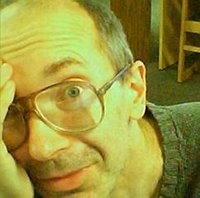 * That’s me on a rare
excursion outside
my apartment tent,
a typical look
of befuddlement
caught by the webcam.
Expeditions of goldfish with sharp spears
trek across carpet hunting fur spiders
living in the corners and dark places.
Beneath vine, tendril, he lives in a tent
seldom venturing out. Sometimes he lifts
a cloth flap to empty an oak bucket—
his waste water, his garbage, his latrine.
Once a day he unzips patchwork screening
and takes into his tent a wooden plate
of fruit and dried meat that the creatures leave—
offerings from the jungle apartment.
He’s a shadow in his tent. Fingers ring
against rusted strings on a wood guitar.
Damp has gently turned the guitar’s fretboard,
curved its body, colored its singing tones.
But the animals—the mice, bats, goldfish,
even the fur spiders in their dark webs—
bring their daily offerings to the sound.
It is their part in the strange, magic place.
Wild civilization, such as it is,
continues in that jungle apartment.
No change of state, just a warping of tone.
A wild man living wild in the wild life.
......................................................................
 * That’s me on a rare
excursion outside
my apartment tent,
a typical look
of befuddlement
caught by the webcam.
Wednesday, November 08, 2006
Alison Dreaming Of Being A Rock And Roll Princess
An electric guitar high and falling,
rotating, above Chicago’s skyline.
Unlike the bone in “A Space Odyssey”
the electric guitar doesn’t edit
into a spaceship or Heywood Floyd’s pen.
The electric guitar rotates, falling,
and crashes through the roof of a building
and falls into a translucent glass hand,
a crystal hand of a crystal princess
standing in a room of jade and topaz
on a floor of sand on top of black wood.
The princess is made of glass, but she moves
and laughs and plays the electric guitar.
An electric guitar. A glass princess.
And the rock and roll she plays is so cool
when the children of her kingdom get sad
she rocks them into a world of laughter.
*
rotating, above Chicago’s skyline.
Unlike the bone in “A Space Odyssey”
the electric guitar doesn’t edit
into a spaceship or Heywood Floyd’s pen.
The electric guitar rotates, falling,
and crashes through the roof of a building
and falls into a translucent glass hand,
a crystal hand of a crystal princess
standing in a room of jade and topaz
on a floor of sand on top of black wood.
The princess is made of glass, but she moves
and laughs and plays the electric guitar.
An electric guitar. A glass princess.
And the rock and roll she plays is so cool
when the children of her kingdom get sad
she rocks them into a world of laughter.
*
Tuesday, November 07, 2006
Alison Dreaming Of The Ultimate Buddy Motion Picture
Call it 25 A.D. — Tiberius
was still in Rome.
Pilate was headquartered in Caesarea
but spending most
of his time in Jerusalem.
John was in the wilderness.
Herodians were busy
trying to win the hearts and minds
of the Jews to the Roman way.
Zealots were agitating
for independence. And Pilate’s wife
began having bad dreams.
That’s when the murders started.
First, the wife of a publican.
The second night the victim
was the mistress of a high priest.
A prostitute familiar
to the centurions died third.
Three deaths over three nights.
But more. The women had connections.
The radicals. The reactionaries.
The lunatic fringe.
Pilate became involved.
His agents told him something was up,
but they couldn’t discern what.
Pilate knew and understood Rome.
The politics of empire.
More importantly, Pilate knew
and understood that his Jewish contacts
had vested interests.
They were limited, defined
by their involvements, commitments.
To find the killer, solve the mystery,
keep the peace, Pilate knew
and understood he needed
an ally from among the Jews.
Someone knowledgeable,
yet independent. Pilate’s agents
told him of a young Jew
from Nazareth, an itinerant
preacher, intimately versed in Scripture,
a teacher, as yet
with no students. Pilate turned
to this man. Pilate met with him.
The two had to find the killer,
solve the mystery, keep the peace.
This is the story
of Pilate and Jesus. Their first meeting.
Their struggle to uncover
an evil vastly greater than
anything either one of them
ever could have imagined.
Before the apostles,
the ministry, the arrest and trial,
before the confrontation
of the Roman man and the Christ,
they were just men, just two men
tracking a psychotic killer.
COMING SOON TO A THEATER NEAR YOU:
.....................................................................
“Blood In The Temple — A Pilate and Jesus Mystery”
*
Monday, November 06, 2006
Alison Dreaming
Last night from outside I watched Alison
fog her ceiling. I stood by a street light
and watched Alison lean out a window
and scoop cupfuls of fog from the damp night.
Then she spooned out the fog into the air
of her apartment. The fog drifted up.
Standing on an ornamental footstool
Alison reached upward and smoothed the fog
with hush and kindness and thoughts of design.
Then she buffed it with a ragged tee shirt
until it shone like imitation pearls
from Woolworth’s. I watched her work for an hour
then I went home and to bed by myself.
Walking for the morning paper, I glanced
in Alison’s window. She was sleeping
on a couch, still wearing her overalls.
Overhead, her ceiling glowed, shimmering
like rice paper through frosted glass. Sleeping,
Alison dreamed. Her dreams drifted upward
glowing, shimmering, too, by her ceiling
like jade statues from a magical past
or like barrettes in a young girl’s long hair.
*
fog her ceiling. I stood by a street light
and watched Alison lean out a window
and scoop cupfuls of fog from the damp night.
Then she spooned out the fog into the air
of her apartment. The fog drifted up.
Standing on an ornamental footstool
Alison reached upward and smoothed the fog
with hush and kindness and thoughts of design.
Then she buffed it with a ragged tee shirt
until it shone like imitation pearls
from Woolworth’s. I watched her work for an hour
then I went home and to bed by myself.
Walking for the morning paper, I glanced
in Alison’s window. She was sleeping
on a couch, still wearing her overalls.
Overhead, her ceiling glowed, shimmering
like rice paper through frosted glass. Sleeping,
Alison dreamed. Her dreams drifted upward
glowing, shimmering, too, by her ceiling
like jade statues from a magical past
or like barrettes in a young girl’s long hair.
*
Friday, November 03, 2006
Jill, At Halloween Time #5
The wide plastic bowl
of warmed-up milk starts steaming
immediately
and just as quickly
goose-bumps form on Jill’s arms when
she pushes open
the back door. “Here girl!”
Jill says. “Snack time!” The llama
hums and purrs and trills
and rubs against Jill.
“That’s return-on-investment,”
Jill whispers. “Good girl.”
The End
Thursday, November 02, 2006
Jill, At Halloween Time #4
Jill checks a mirror
and straightens out her new bra.
She starts walking back
to the kitchen but
hears a noise in the front room.
She stops, frowns, looks in.
On her computer
a tech chart is flashing and
the speaker’s beeping.
‘Some stock’s changed,’ Jill thinks,
starting in. She stops. ‘The milk,’
Jill thinks. ‘Stocks or milk?’
*
and straightens out her new bra.
She starts walking back
to the kitchen but
hears a noise in the front room.
She stops, frowns, looks in.
On her computer
a tech chart is flashing and
the speaker’s beeping.
‘Some stock’s changed,’ Jill thinks,
starting in. She stops. ‘The milk,’
Jill thinks. ‘Stocks or milk?’
*
Wednesday, November 01, 2006
Jill, At Halloween Time #3
Standing by the bed,
Jill looks at her broken bra.
A small plastic ring
that attached the left
cup to the left shoulder strap
had cracked and vanished.
‘Looked cheap in the store,’
Jill thinks, ‘and it really was.
How often do things
in real life end up
being actually what
they appear to be?’
*
Jill looks at her broken bra.
A small plastic ring
that attached the left
cup to the left shoulder strap
had cracked and vanished.
‘Looked cheap in the store,’
Jill thinks, ‘and it really was.
How often do things
in real life end up
being actually what
they appear to be?’
*
Tuesday, October 31, 2006
Jill, At Halloween Time #2
Jill turns the gas low.
She walks to the front bedroom
to get a new bra.
Walking, she reaches
both hands around behind her
to unclip her bra.
Topless, she thinks, ‘Oops,
in all the thriller movies
when a woman leaves
something on the stove
and goes out of the kitchen,
that’s when she’s attacked . . .’
*
She walks to the front bedroom
to get a new bra.
Walking, she reaches
both hands around behind her
to unclip her bra.
Topless, she thinks, ‘Oops,
in all the thriller movies
when a woman leaves
something on the stove
and goes out of the kitchen,
that’s when she’s attacked . . .’
*
Monday, October 30, 2006
Jill, At Halloween Time #1
Her stocks are tanking,
the llama’s constipated
and her bra strap broke.
Jill wants to cry but
she just can’t. Something about
Halloween season
gives her energy.
In the kitchen she warms milk
for the llama. Leaves—
brown, yellow, orange—
blow past the kitchen window.
Jill sighs, stirs the milk.
*
the llama’s constipated
and her bra strap broke.
Jill wants to cry but
she just can’t. Something about
Halloween season
gives her energy.
In the kitchen she warms milk
for the llama. Leaves—
brown, yellow, orange—
blow past the kitchen window.
Jill sighs, stirs the milk.
*
Friday, October 27, 2006
Ansel Adams And Alfred Stieglitz, #2
I believe that the artist and his art are only a part of the total human experience; the viewer in the world at large is the essential other part. I feel that a true work of art is like nothing else in the world. It is not essential to know how the artist thinks or how he believes he relates to his profession or his society. What he creates is his message. For me a work of art does not cry for comprehension, only for reaction at the level of art itself.
Stieglitz taught me what became my first commandment: “Art is the affirmation of life.”Ansel Adams
“Ansel Adams: An Autobiography”

Thursday, October 26, 2006
Ansel Adams And Alfred Stieglitz, #1
Anticipation is another prime element of creative art and essential to visualization. Some years ago I was talking with Edwin Land, a brilliant scientist and close friend. We talked about the remarkable photographs of Henri Cartier-Bresson, with his images of people in motion arrested at precisely the optimum expressive moment of time and place.
Land pointed out that the moment captured on film was realized through anticipation. Had Cartier-Bresson released the shutter at the “decisive moment” as revealed in his pictures, the psycho-physical lag would have resulted in capturing the moment after the ideal position in the composition.
Anticipation is one of the most perplexing capabilities of the mind: projection into future time. Impressive with a single moving object, it is overwhelming when several such objects are considered together and in relation to their environment. I believe that the mind, working at incredible speeds, is able to probe into the future as well as recall the past. Our explorations of the past support the present, and our awareness of the present will clarify the future.
... Photography is an investigation of both the outer and inner worlds. One might consider that if one is born an explorer he will never find existence dull. The first experiences with the camera involve looking at the world beyond the lens, trusting the instrument will “capture” something “seen.” The terms shoot and take are not accidental; they represent an attitude of conquest and appropriation. Only when the photographer grows into perception and creative impulse does the term make define a condition of empathy between the external and internal events. Stieglitz told me, “When I make a photograph, I make love!”Ansel Adams
“Ansel Adams: An Autobiography”
Wednesday, October 25, 2006
Ansel Adams And Edwin Land
Once Din [“Din” was Edwin Land’s nickname] and I went to Dr. Harold Edgerton’s laboratory at Massachusetts Institute of Technology to observe the making of a strobe flash picture of a bullet piercing a balloon, recorded on a new Polaroid transparency material. The extremely short electronic flash was fired by microphone. We stood around, expectantly waiting for the firing, fully briefed on what was to occur and how safe it was. The revolver was securely lashed to a firm support, and there was an efficient sand trap to catch the bullet. The balloon was filled with talcum powder, inflated, and properly placed in the line of fire. The camera was focused upon it, all ready to go. At the moment of firing, one of Edgerton’s assistants struck a large segment of rail with a heavy metal mallet. The sound was terrific, and all but Edgerton and Land hit the floor. Great hilarity ensued. The photograph came out perfectly, with the bullet clearly emerging in a cloud of talcum from the still-tense surface of the balloon; at the moment of exposure the balloon had not had time to think about collapsing.
… [Edwin Land’s] philosophy and humanity are revealed in the statement he made on April 2, 1979, on the occasion of the opening of the new home of the academy [Edwin Land had been president of the American Academy of Arts and Sciences from 1951-54]:
“Each stage of human civilization is defined by our mental structures: the concepts we create and then project upon the universe. They not only redescribe the universe but also in so doing modify it, both for our own time and for subsequent generations. This process—the revision of old cortical structures and the formulation of new cortical structures whereby the universe is defined—is carried on in science and art by the most creative and talented minds in each generation. For individuals to contribute to this constantly evolving projection of mental structures upon the universe, it is necessary for them to concentrate on one area of knowledge or experience, and thus they limit themselves by excluding many other areas. This Academy’s function is to associate many specialized lines of concentration by gathering the individuals in whom they are embodied. Thus, while each person is narrowed by his own specialization, the group as a whole is enriched.
“The transfer of concepts as models from one field to another requires intimacy, informality and friendliness because the transfer usually is not a conscious process. Models for physics may come from music, for chemistry from physics, for art from cosmology. … The great historic periods of spectacular human advance, within time spans of relatively few generations, may have been periods in which society made possible the concentrated interplay of the separate contributions of creative individuals. There is no way in which we can tell whether we are entering such a period of history, but whether or not we are, the role of the Academy seems clear.”Ansel Adams
“Ansel Adams: An Autobiography”
Tuesday, October 24, 2006
Ansel Adams And Cedric Wright
I am interested in why I see certain events in the world about me that others do not see, while they respond to different events. On the day that this photograph was made there were several other photographers nearby, some very good ones who were then far more technically advanced than I. The scene was before us all, but no one else responded with creative interest. Cedric Wright, close friend, violinist, and photographer from Berkeley, observed what I was doing and, half in jest, set his camera up in my location. I saw his print later; he did not have a lens of appropriate focal length and he overexposed his negative. On seeing my print he exclaimed, “Jeez! Why didn’t I see that!”
Ansel Adams
“Examples: The Making
Of 40 Photographs”

Monday, October 23, 2006
Ansel Adams And Margaret Bourke-White
One of the most successful Life photographers was Margaret Bourke-White, whom I first met in 1934. She had just moved into her studio on one of the top floors of the Chrysler Building and I recall a giant aluminum gargoyle clearly visible through the large window. Her assistant, a nervous young man, said, “Please be seated,” but there was nothing to sit on. Bourke-White entered the room briskly and cordially greeted me. She was dressed with great chic, on the edge of flamboyancy, and moved and talked with marvelous vitality. She explained that she was preparing for an assignment and could give me but a few moments—“My helper is checking my cameras right now.” At that moment a loud crash came from the adjacent room; the camera and tripod on which the young man was working had suddenly collapsed and were severely damaged. Bourke-White reacted with composure, saying to him, “Please call for another Speed Graphic right away.” Stating she would pick up the camera on the way to the airport, she gave me a warm adieu, abandoning me in her pristine office with the broken camera still lying on the floor.
Ansel Adams
“Ansel Adams: An Autobiography”
Friday, October 20, 2006
Paris Hilton And The Butterflies From Atlantis #5: The Butterflies From Atlantis
At the Oak Lawn Public Library where
I often check out books and DVDs
and use the public access computers,
if you browse through the stacks looking for books
like “Fishing The Dry Fly As A Living
Insect,” or, less fish, like “Trout Fishing In
America,” you won’t find them because
such books aren’t there to be found. They’re gone.
If you browse the internet for such books
you find them equally lost, but not gone,
just buried among eighty-three million
references to what Paris Hilton did
two nights ago, or many million more
equally fishy references that may
or may not say anything about trout.
*
I miss good books. Good. As opposed to books
demographically targeted—conceived,
designed and produced to strip-mine every
dollar from every market in the world.
*
When I checked out the book Paris Hilton
wrote with Merle Ginsberg and read in the park,
I sat with the book in my hand, my hand
resting in my lap and the book open
in front of me. An open book like that,
the spine in my hand, pages to the left
and to the right, looks like a butterfly.
Butterflies bask in the sun, wings open
left and right, warming themselves in the light.
Books lie open in front of us, pages
left and right, like butterflies letting us
study the pretty patterns on their wings.
But books aren’t like real butterflies from
the physical place we remember as
Atlantis. Books are like butterflies from
Atlantis, the magical place of myths.
Books are like butterflies from Atlantis,
the magical place of myths. They fly us
not by their wings, but the pretty patterns
on their wings, to worlds long gone, to worlds lost,
to lost worlds of artist and expression,
to lost worlds of designer and knowledge,
to lost worlds, too, of jester and routine.
Like “Confessions Of An Heiress.” Or this.
Books. They’re like butterflies from Atlantis.

I often check out books and DVDs
and use the public access computers,
if you browse through the stacks looking for books
like “Fishing The Dry Fly As A Living
Insect,” or, less fish, like “Trout Fishing In
America,” you won’t find them because
such books aren’t there to be found. They’re gone.
If you browse the internet for such books
you find them equally lost, but not gone,
just buried among eighty-three million
references to what Paris Hilton did
two nights ago, or many million more
equally fishy references that may
or may not say anything about trout.
*
I miss good books. Good. As opposed to books
demographically targeted—conceived,
designed and produced to strip-mine every
dollar from every market in the world.
*
When I checked out the book Paris Hilton
wrote with Merle Ginsberg and read in the park,
I sat with the book in my hand, my hand
resting in my lap and the book open
in front of me. An open book like that,
the spine in my hand, pages to the left
and to the right, looks like a butterfly.
Butterflies bask in the sun, wings open
left and right, warming themselves in the light.
Books lie open in front of us, pages
left and right, like butterflies letting us
study the pretty patterns on their wings.
But books aren’t like real butterflies from
the physical place we remember as
Atlantis. Books are like butterflies from
Atlantis, the magical place of myths.
Books are like butterflies from Atlantis,
the magical place of myths. They fly us
not by their wings, but the pretty patterns
on their wings, to worlds long gone, to worlds lost,
to lost worlds of artist and expression,
to lost worlds of designer and knowledge,
to lost worlds, too, of jester and routine.
Like “Confessions Of An Heiress.” Or this.
Books. They’re like butterflies from Atlantis.
Subscribe to:
Posts (Atom)
